
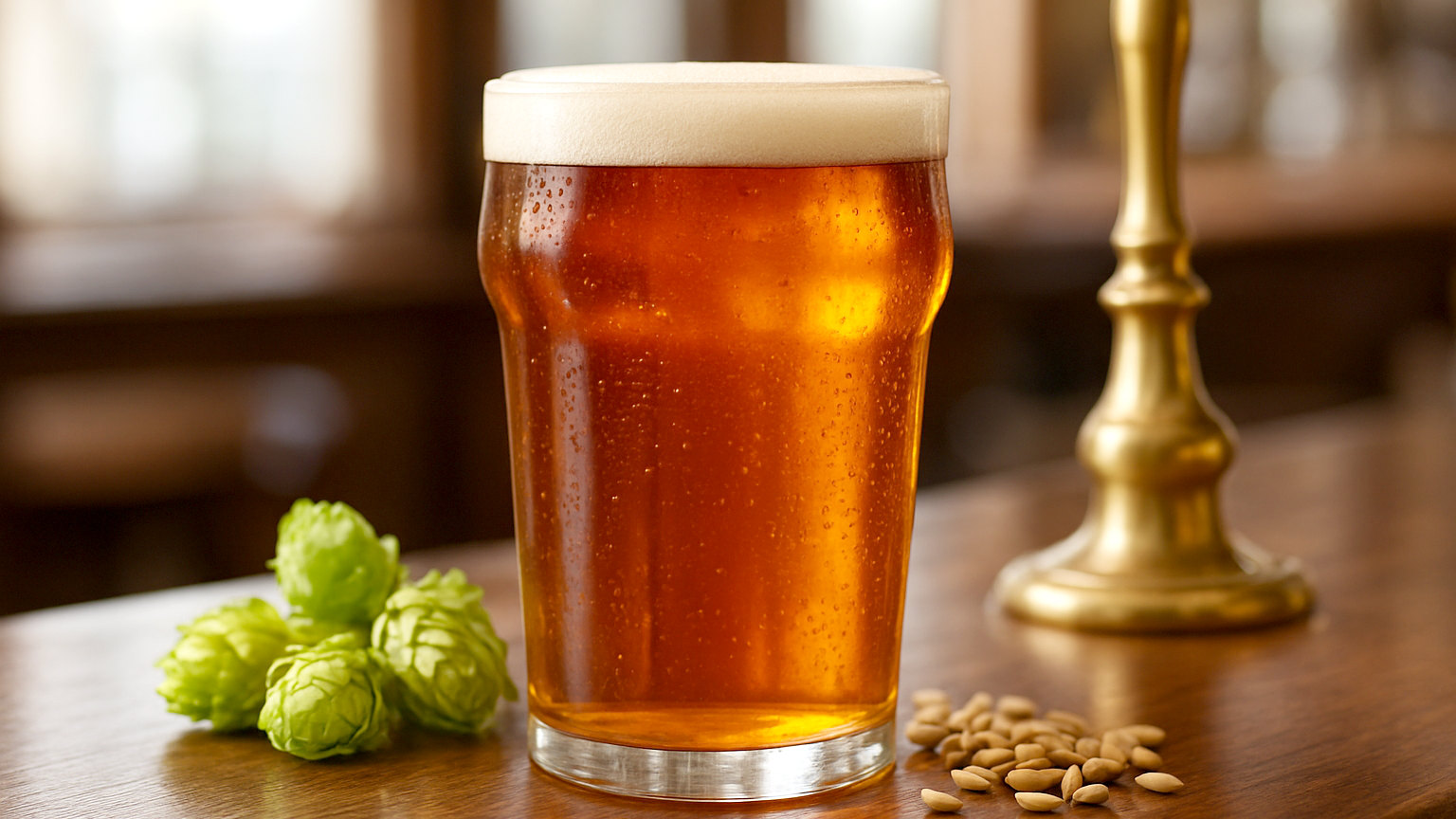
Bitter is the most misunderstood name in British brewing, because by modern standards it is not especially bitter at all. A typical bitter sits around 30 IBU, which is lower than most pale ales and less than half a West Coast IPA. The name is a comparison with something that no longer exists.
Why is it called bitter?
Because it was named against mild, the sweeter and less hopped beer it was sold alongside in Victorian and Edwardian pubs. Relative to mild, it was noticeably bitter, and drinkers asked for it by that description until the name stuck.
Mild has largely disappeared, so the comparison that gave bitter its name is no longer available. What remains is a name that misleads anyone encountering it fresh.
What defines the style?
- Strength: 3.5 to 5.5 per cent depending on the sub-style.
- Colour: gold to deep amber.
- Bitterness: around 25 to 40 IBU.
- Hops: English varieties, earthy and floral rather than citrus.
- Malt: biscuity and nutty, usually from Maris Otter, with caramel from crystal malt.
- Yeast: English ale strains, contributing mild stone fruit notes.
The defining quality is balance. Neither the malt nor the hops should dominate, and a well-made bitter tastes of both at once with a dry finish that invites another mouthful.
What are the sub-styles?
- Ordinary bitter. 3.2 to 3.8 per cent. The lightest, and the hardest to brew well.
- Best bitter. 3.8 to 4.6 per cent. The most common.
- Extra special bitter, or ESB. 4.6 to 6 per cent. Fuller, more caramel, longer finish.
They are the same beer built at different strengths rather than three separate recipes, which makes brewing all three across a few months a genuinely instructive exercise.
Why is ordinary bitter hard to brew?
Because at 3.5 per cent there is very little alcohol to carry flavour and no strong hop or roast character to hide a fault. Every mistake shows. It is a better test of technique than any big beer.
How should it be served?
At cellar temperature, 11 to 13 degrees, with low carbonation, ideally from a cask. This is not tradition for its own sake: cold suppresses the malt aroma that the style is built on, and heavy carbonation makes it feel sharp and prickly.
A bitter served at 4 degrees from a fridge tastes like faintly bitter water. The same beer twenty minutes later is a different drink entirely, and it is worth trying the comparison once.
What is cask ale?
Beer that finishes conditioning in the container it is served from, with live yeast still present and no added gas. It is served by hand pump or gravity, which is why cask beer is softer and less fizzy than keg.
Cask is a serving method rather than a style, and bitter is the style most associated with it. A cask bitter kept well is one of the best things in British brewing, and a badly kept one is why the format has a mixed reputation.
Is it worth seeking out?
Yes, particularly if strong modern beers feel like hard work. Bitter is designed for drinking two or three of over an evening rather than for making an impression, which is an underrated quality in a beer.
Why has it declined?
A mix of fashion, the difficulty of keeping cask beer well, and the arrival of stronger, more assertive styles. A pub that keeps its cask lines poorly will produce bad bitter, and one bad pint puts people off a whole style.
Where it is kept properly it remains one of the best-value and most drinkable things on any bar, which is why it is worth trying again in a pub that clearly takes it seriously.
How does it differ from pale ale?
Less than the names suggest. English pale ale and bitter overlap heavily, and the distinction is often which word the brewery preferred. As a working guide, bitter tends to be lower in strength, served cask and cooler in carbonation.


