
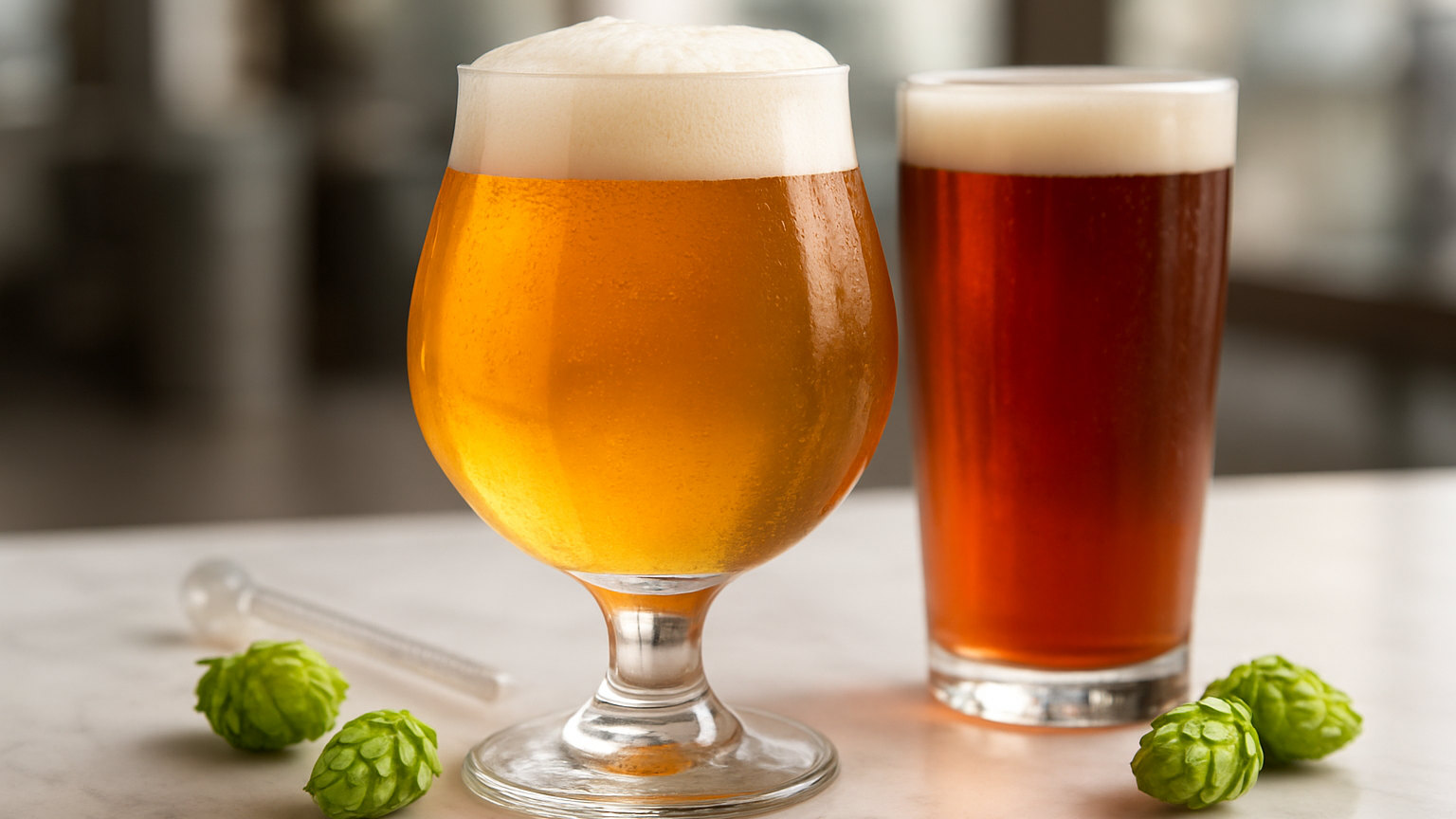
ABV and IBU are the two numbers most likely to appear on a can, and they are not equally reliable as guides to what is in it. One is a straightforward measurement and the other describes something your palate only partly perceives.
What is ABV?
Alcohol by volume, expressed as a percentage. A 5 per cent beer is 5 per cent alcohol by volume, and it is legally required on the label in the UK.
It is measured by comparing the density of the wort before fermentation with the density afterwards, since alcohol is less dense than water. That is the same calculation a home brewer makes with a hydrometer.
How do you turn it into units?
Volume in millilitres multiplied by the percentage, divided by 1000.
- Pint of 4 per cent: 2.3 units.
- Pint of 5.5 per cent: 3.1 units.
- 440ml can of 6 per cent: 2.6 units.
- 330ml bottle of 9 per cent: 3 units.
Against the guideline of no more than 14 units a week spread over three or more days, style choice makes a substantial difference across an evening.
What is IBU?
International Bitterness Units, a laboratory measurement of iso-alpha acids, the compounds hops contribute during the boil that produce bitterness. It is measured by spectrophotometry rather than by tasting.
As a rough scale:
- Under 20: barely bitter. Wheat beer, helles, milk stout.
- 20 to 35: moderate. Bitter, brown ale, porter.
- 35 to 50: noticeable. Pale ale.
- 50 to 70: assertive. IPA.
- 70 and above: aggressive. Double IPA.
Why does IBU only half work?
Because perceived bitterness depends on what else is in the beer. Sugar suppresses bitterness, so a malty, sweet beer at 50 IBU can taste less bitter than a dry one at 35.
That is why a hazy IPA hopped heavily can measure high and taste soft, while a West Coast IPA at the same figure tastes bracing. The number describes the chemistry, not the sensation.
IBU also does not capture aroma at all. A beer dry hopped heavily after fermentation gains enormous hop character and almost no IBU, since dry hopping contributes very few iso-alpha acids.
Is there a ceiling?
In practice, yes. Human perception saturates somewhere around 100 IBU, so beers advertising 150 or 1000 are making a marketing point rather than a sensory one. Above about 100 you cannot tell the difference.
What is the balance ratio?
Some brewers use the ratio of IBU to gravity points as a better guide to how a beer will read. A beer at 50 IBU from a 1.070 wort is balanced; the same 50 IBU from a 1.040 wort is sharp and thin.
That is why session IPAs need careful handling. There is less malt to balance the bitterness, so the same IBU figure lands much harder.
What other numbers appear?
- SRM or EBC. Colour scales. Low is pale, high is dark.
- OG and FG. Original and final gravity. Mostly of interest to brewers.
- Plato. An alternative gravity scale, common in Europe.
Which should you actually use?
ABV always, since it tells you what you are drinking. IBU as a rough directional guide, treated with suspicion. And the packaging date over both, since a stale IPA is a worse beer than a mismatched IBU figure would ever produce.
Is ABV always accurate?
Within a tolerance. UK labelling permits a margin of around 0.5 percentage points either way, so a beer stated at 5 per cent might be 4.6 or 5.4. That is small enough not to matter for enjoyment and worth knowing if you are counting closely.
Which numbers are missing?
The most useful ones. Nothing on a label tells you the final gravity, the residual sweetness or the balance between them, all of which affect how a beer reads more than IBU does. Style name and packaging date remain better predictors than either figure.
Do brewers always publish IBU?
Increasingly not, and reasonably so. Since perceived bitterness diverges from the measurement, some breweries have stopped quoting it on the grounds that it misleads more than it helps.


