
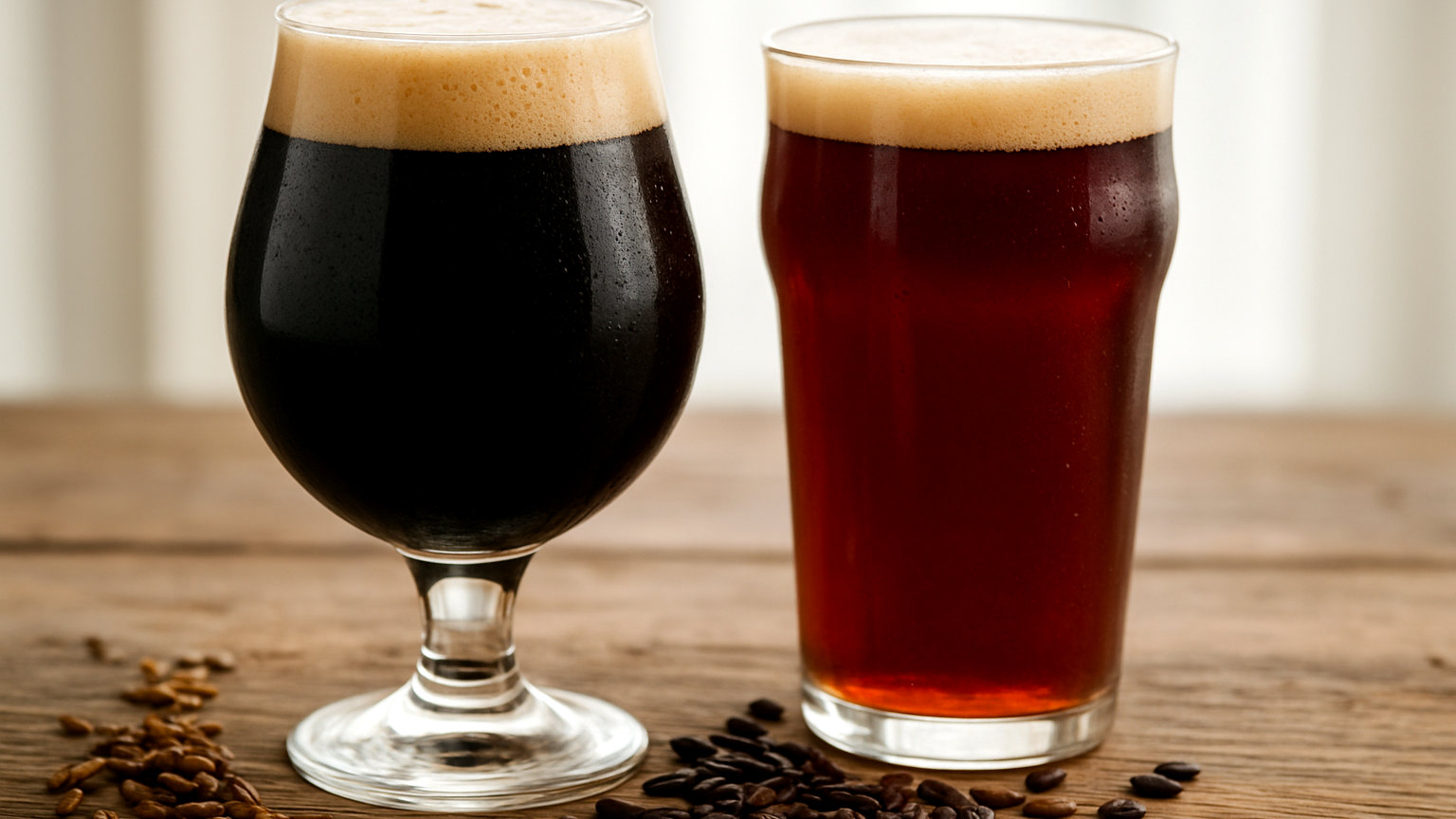
This question has no clean answer, and anyone who gives you one confidently is glossing over two centuries of the boundary moving. There is still a useful working distinction, provided you understand it as a modern convention rather than a rule.
What is the historical origin?
Porter came first, in eighteenth-century London, named for the market porters who drank it. Stout originally meant strong, so a stout porter was simply a stronger version of the same beer.
Over time the word stout detached from porter and became a style name in its own right. So historically, stout is a subset of porter rather than a separate thing.
What is the modern distinction?
The most useful current line is the grain:
- Stout typically uses roasted barley, which is unmalted and heavily roasted, giving sharp coffee bitterness and a dry finish.
- Porter typically uses chocolate and brown malt, giving a smoother, rounder cocoa character with less acrid edge.
That is a genuine difference you can taste. A dry Irish stout has a bitter coffee snap that a porter does not, and a porter has a biscuity, dry-toast depth from brown malt that a stout usually lacks.
Is the line reliable?
No. Plenty of beers labelled porter use roasted barley and plenty of stouts use chocolate malt. Brewers name beers for commercial reasons as much as technical ones, and the categories overlap heavily in the middle.
What are the stout sub-styles?
- Dry or Irish stout. Around 4 to 4.5 per cent, roasted barley, dry and bitter.
- Milk or sweet stout. Lactose added, which yeast cannot ferment, so it stays as sweetness and body.
- Oatmeal stout. Oats add a silky, slightly viscous texture.
- Imperial stout. 8 to 12 per cent, intense, and ages for years.
- Oyster stout. Historically served with oysters, and some genuinely contain them.
What are the porter sub-styles?
- Brown porter. Around 4.5 to 5.5 per cent, chocolate-led, moderate.
- Robust porter. Stronger and more roasted, close to the stout boundary.
- Baltic porter. Strong, often lager-fermented, smooth and rich at 7 to 9 per cent.
Baltic porter is the outlier and worth knowing about, since it is frequently made with lager yeast at cold temperatures, which makes it a dark lager wearing a porter name.
How should they be served?
Warmer than most people expect, around 10 to 13 degrees. Roast and chocolate flavours are largely suppressed below about 8 degrees, and a stout straight from a cold fridge tastes thin and one-dimensionally bitter.
Twenty minutes out of the fridge transforms both styles. This is the single change that makes most people reconsider dark beer.
Does the difference matter?
For ordering a pint, barely. Both are dark, roasty and moderately bitter, and someone who enjoys one will generally enjoy the other.
For brewing, it matters a great deal, since roasted barley and chocolate malt are not interchangeable in equal weights. Swapping one for the other produces a noticeably harsher or noticeably sweeter beer, which is where the distinction earns its keep.
Which should you brew first?
Either, and both are forgiving, since the roast character masks a great deal. That is also the argument against starting there, because a fault you cannot taste is a lesson you do not learn.
What about the nitrogen question?
Many commercial dry stouts are served with a nitrogen blend rather than carbon dioxide, which produces the dense creamy head and a much softer mouthfeel. That is a dispensing choice rather than a style requirement, and the same beer from a bottle tastes noticeably sharper.
How should you choose between them?
By what you want from the roast. If you want a sharp coffee bitterness and a dry finish, look for a dry stout. If you want cocoa and biscuit with a rounder edge, look for a porter. Everything in the middle is a matter of the individual beer rather than the label.
Do they age well?
The strong ones do. An imperial stout at 10 per cent will develop for one to three years, gaining dried fruit and sherry notes. A 4 per cent dry stout is at its best within a couple of months and gains nothing from keeping.


