
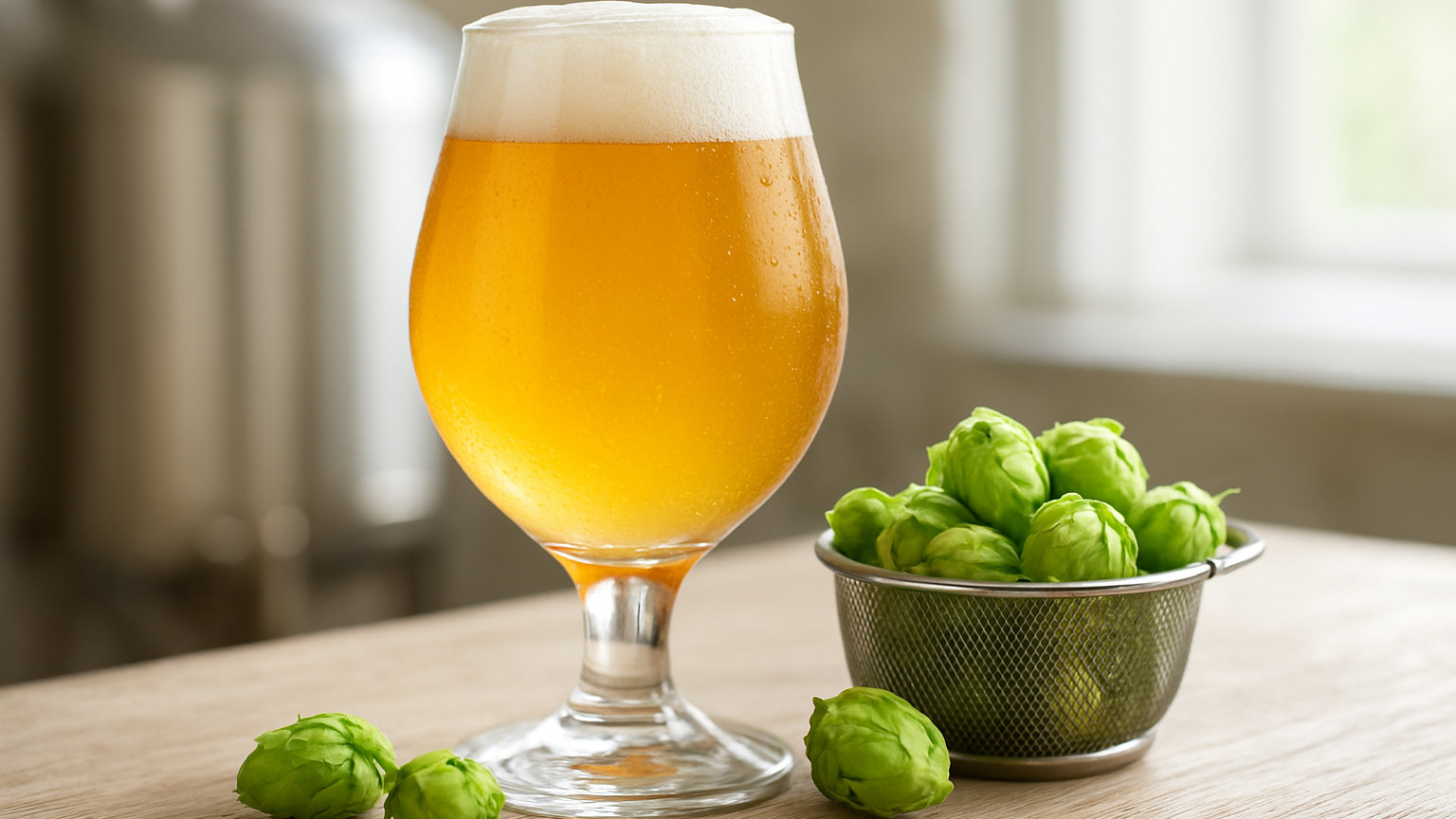
Dry hopping means adding hops to beer after the boil, when no heat is driving off the volatile oils. It is the only way to get intense hop aroma into a finished beer, and it is straightforward. The variables that decide whether it works are timing, temperature and contact time, and quantity comes fourth.
When in the process should you add them?
The best window is the last day or two of active fermentation, when the gravity has nearly stabilised but a little carbon dioxide is still being produced.
The reason is oxygen. Opening a fermenter lets air in, and oxygen destroys hop aroma within days and gives beer a stale, cardboard character. Adding hops while fermentation is still producing gas means that gas pushes the oxygen back out.
Adding hops after fermentation has completely finished works, but the beer is at its most vulnerable then and the aroma will fade faster.
How long should they stay in contact?
Three days is the working answer for most beers. Extraction of the desirable aromatic oils happens quickly, largely within the first twenty-four to forty-eight hours.
Beyond about five days you start pulling out chlorophyll and plant compounds, which give a grassy, vegetal, tea-like character. Leaving hops in for two weeks does not produce a more aromatic beer, it produces a worse one.
Does the temperature matter?
Considerably, and it changes the character rather than just the intensity:
- Warm, 18 to 20 degrees: more oil extracted, bigger and juicier aroma.
- Cold, near zero: less extraction, cleaner and more delicate result.
Modern hazy and juicy styles are dry hopped warm. Lagers and delicate pale beers are often dry hopped cold. Neither is wrong, they are different targets.
How much should you use?
By style, for a 23 litre batch:
- Pale ale: 50 to 80g
- IPA: 100 to 150g
- Session ale: 50 to 70g
- Lager: 25 to 40g
- Stout or brown ale: usually none
There is a ceiling. Past roughly 8g per litre the returns fall away sharply and the beer starts tasting harsh and vegetal rather than more aromatic. Doubling the hops does not double the aroma.
What is hop creep and why does it matter?
Hops carry enzymes that break down long-chain sugars the yeast previously could not ferment. Add hops to a finished beer and those sugars become available, the yeast restarts, and the gravity drops further.
In a sealed bottle that means extra carbon dioxide, and it is a genuine cause of over-carbonated and occasionally burst bottles in heavily dry hopped beers. It is more pronounced with large dry hop charges and warmer temperatures.
The protection is straightforward. After the dry hop, wait several days and confirm the gravity is stable again before bottling, rather than relying on a reading taken before the hops went in. Prime at the lower end and use bottles rated for pressure.
Should you remove the hops afterwards?
Ideally yes. A muslin bag or a stainless mesh tube lets you lift them out cleanly after three days, and it keeps loose hop matter out of the bottling process.
Loose pellets are perfectly workable and simply settle into a sludge at the bottom of the fermenter. Cold crashing for a day compacts that layer and makes racking off it much easier.
Which hops are worth using?
Those with high oil content and distinctive aroma, since that is the only thing you are extracting. Citra, Mosaic, Nelson Sauvin, Galaxy and Simcoe all reward dry hopping. High-alpha bittering hops with little aromatic character contribute very little and are better used in the boil.
Freshness is critical. Hops stored warm or in a partly open bag lose their volatile oils within months, and stale hops give a cheesy note that is unmistakable once you have encountered it. Keep them vacuum sealed in the freezer.
Buy in the quantities you will use within a season rather than in bulk. A kilogram bought cheaply and opened repeatedly across two years will make worse beer than a series of small fresh packets.


