
Most published recipes are written for either 19 or 23 litres, and most home brewers make something else. Scaling looks like simple multiplication and mostly is, but three elements behave awkwardly and getting them wrong is why a scaled recipe often lands well off its target.
What scales in direct proportion?
Grain, sugar and yeast nutrient all scale linearly. To go from 23 litres to 11.5, halve everything. To go from 19 to 23, multiply by 1.21.
Water scales too, though not quite as simply, because the ratio of water to grain in the mash should stay constant. Aim for roughly 2.6 litres per kilogram of grain regardless of batch size, then calculate the sparge volume from what you need in the kettle.
Why do hops not scale linearly?
Because hop utilisation depends on the gravity of the wort during the boil, not just its volume. In a concentrated boil, where you boil a small volume and dilute afterwards, the sugars interfere with isomerisation and you extract fewer bitter compounds per gram.
If you are boiling the full volume at both sizes, hops scale in proportion and you can multiply as normal. If you are doing a partial boil, expect to need around 20 to 25 per cent more hops for the same bitterness. This is the single most common reason a scaled recipe comes out tasting flat.
Does this affect late hops too?
Less so. Whirlpool and dry hop additions are about aroma rather than isomerisation, and they scale in proportion to the finished volume fairly reliably. It is the bittering addition that needs the adjustment.
How does efficiency change with batch size?
Brewhouse efficiency is the percentage of available sugar you actually extract from the grain, and it is not a fixed property of a recipe. It is a property of your equipment and technique.
Smaller batches often run at higher efficiency because the grain bed is shallower and rinses more evenly. Larger batches on the same equipment often drop, sometimes by five percentage points or more. A recipe written at 75 per cent efficiency will come out weak if your system runs at 68.
The fix is to measure your own efficiency across two or three brews, then adjust the grain bill up or down to hit the target gravity rather than trusting the published weights.
What about boil off?
Evaporation is driven by surface area and boil vigour, not by volume. A wide kettle boiling 11 litres will lose a similar absolute amount of water to the same kettle boiling 23 litres, which means it loses a much larger percentage.
Measure your own rate once. Boil a known volume of water hard for sixty minutes and measure what is left. That figure, in litres per hour, is more useful than any published estimate and it lets you calculate the pre-boil volume for any batch size.
What changes for very small batches?
Below about 10 litres, several things become awkward:
- A standard packet of yeast is a large overpitch. Use half, or make a smaller starter.
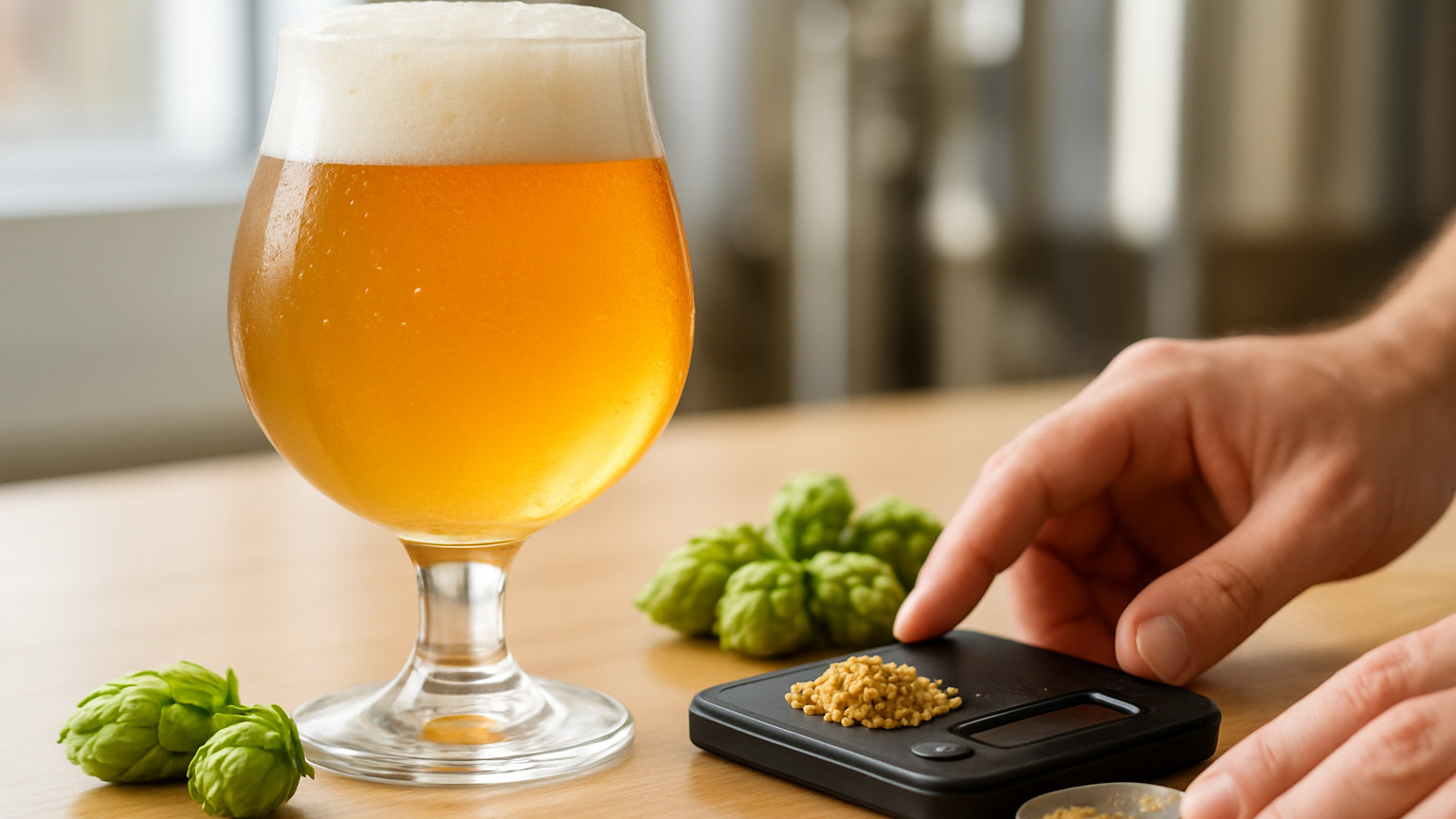
- Hop weights fall below what most kitchen scales measure accurately. A 0.1g scale becomes necessary.
- Losses to trub and hop absorption take a much larger percentage of the batch.
- Temperature swings faster, so fermentation control matters more.
None of these is a reason to avoid small batches, which are an excellent way to test a recipe cheaply. They just need the losses building into the plan rather than discovered afterwards.
When should you not scale a recipe at all?
When the process rather than the ingredients defines it. A recipe relying on a long slow sparge, a decoction mash or a specific kettle geometry will not simply transfer to different equipment.
In those cases it is better to treat the published recipe as a description of a target beer, and work backwards to your own system, than to attempt a direct conversion of the numbers.


