
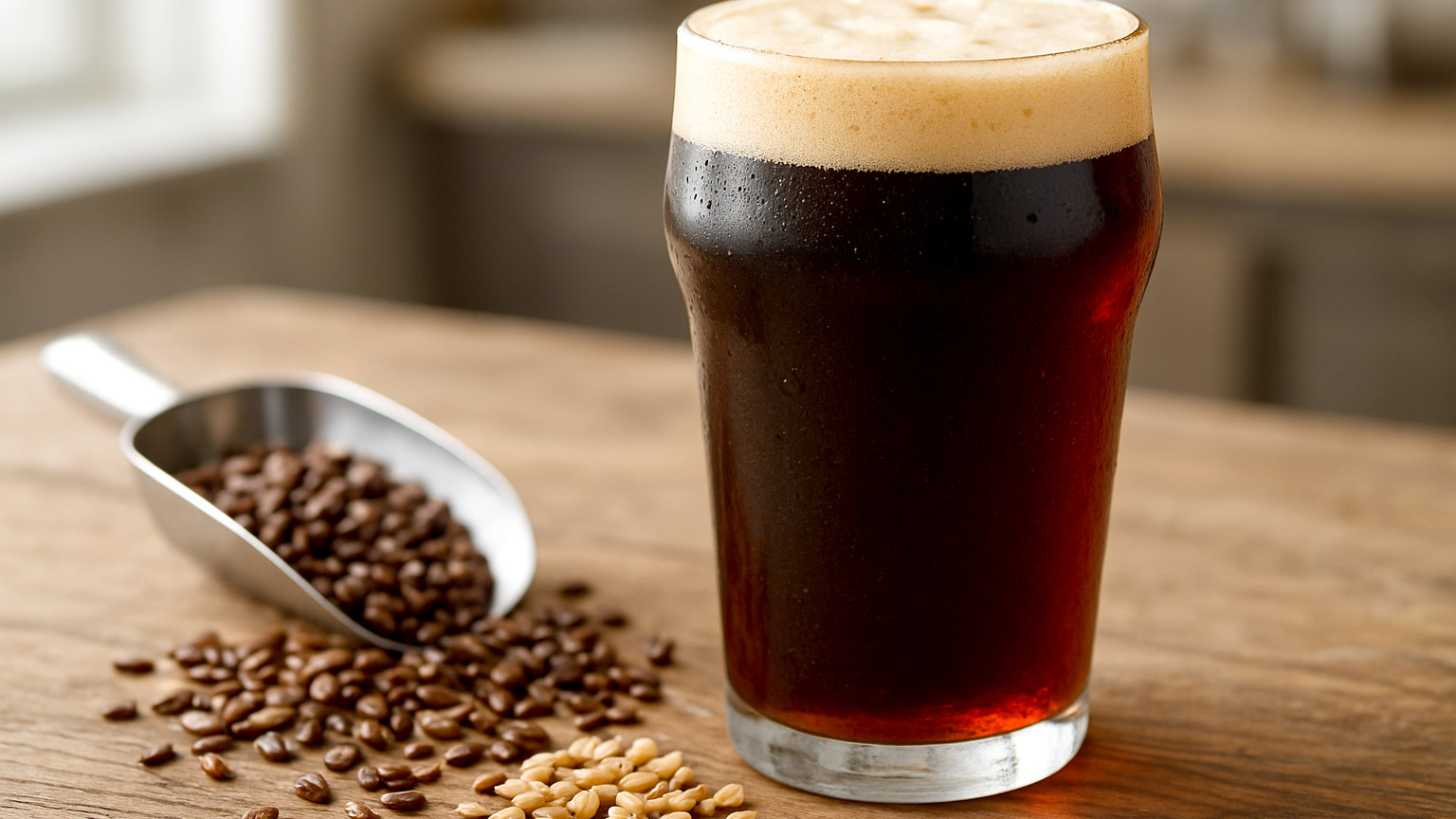
Porter and stout have argued over the same territory for two centuries and the boundary has moved repeatedly. In practice today, the useful distinction is the grain: porter leans on chocolate and brown malt for a rounded, cocoa-led darkness, while stout usually leans on roasted barley for a sharper coffee bitterness.
What is the grain bill?
For 23 litres at around 5.4 per cent:
- 4.5kg Maris Otter pale malt
- 400g brown malt
- 300g chocolate malt
- 250g crystal malt, medium
Brown malt is the ingredient that defines the style and it is often left out of modern recipes. It gives a dry, biscuity, faintly smoky note that neither chocolate malt nor crystal can replicate. Without it a porter tends to taste like a slightly weak stout.
Why avoid roasted barley here?
Because it brings the sharp, acrid coffee bitterness that pushes the beer towards dry stout. There is nothing wrong with that flavour, but it is not what a porter is aiming at, and a small amount goes a long way.
If you want a hint of it, 75g is the maximum before the character starts to dominate. Most porters are better without any at all.
How do you keep it from tasting astringent?
Astringency in a dark beer is a drying, tea-like harshness at the back of the throat, and it comes from tannins pulled out of the dark grain husks. Three things control it:
- Sparge water temperature. Keep it at or below 76 degrees. Hotter water extracts tannins aggressively.
- Sparge water pH. Above about 6.0 the extraction increases sharply. A small addition of acid brings it down.
- Late grain addition. Add the dark malts for the final fifteen minutes of the mash rather than the whole hour.
The last of these is the easiest and gives the biggest improvement for the least effort. It is worth doing as standard in any dark beer.
What mash temperature suits it?
Sixty-seven degrees for sixty minutes. Porter wants a medium to full body without being sweet, and this sits comfortably between the two.
What hop schedule works?
Modest and English. Thirty-five grams of a traditional hop such as Fuggles or Challenger at 60 minutes, aiming for around 30 IBU, and nothing later.
The dark grains contribute considerable perceived bitterness of their own, so the hop bitterness only needs to fill in behind them. Late hop additions are largely wasted, since the roast and chocolate character will bury any aroma.
Which yeast should you pitch?
An English ale yeast at 19 to 20 degrees. The mild fruitiness suits the malt profile, and the moderate attenuation leaves enough residual sweetness to balance the roast.
A very clean American yeast will give a drier, starker porter. It works, but you lose some of the roundness the style is known for. If you use one, consider mashing two degrees warmer to compensate.
How should you carbonate and serve it?
Around 100g of sugar for the batch, giving moderate carbonation. Lower than a pale ale, higher than a dry stout.
Serve between 10 and 13 degrees. Chocolate and roast flavours open up considerably as a dark beer warms, and the difference between a porter at 5 degrees and the same beer at 12 is dramatic. Pour it cold if you must, then leave it fifteen minutes before deciding what you think of it.
When is it at its best?
Later than most ales. Two weeks to carbonate, then at least another three or four to condition. The brown malt in particular can taste slightly rough in a young beer and mellows noticeably over a month.
Porter also keeps well. Stored cool and dark it will hold for six months and often improves over the first three, which makes it a sensible style to brew in a larger batch than you can drink quickly.
Which variations are worth trying?
Adding 300g of lactose gives a sweeter, fuller version. Adding 100g of cacao nibs to the fermenter for five days deepens the chocolate note without adding sweetness. A vanilla pod split and added at the same stage works particularly well against brown malt. All three keep the base recipe intact, which makes them easy to judge.


