
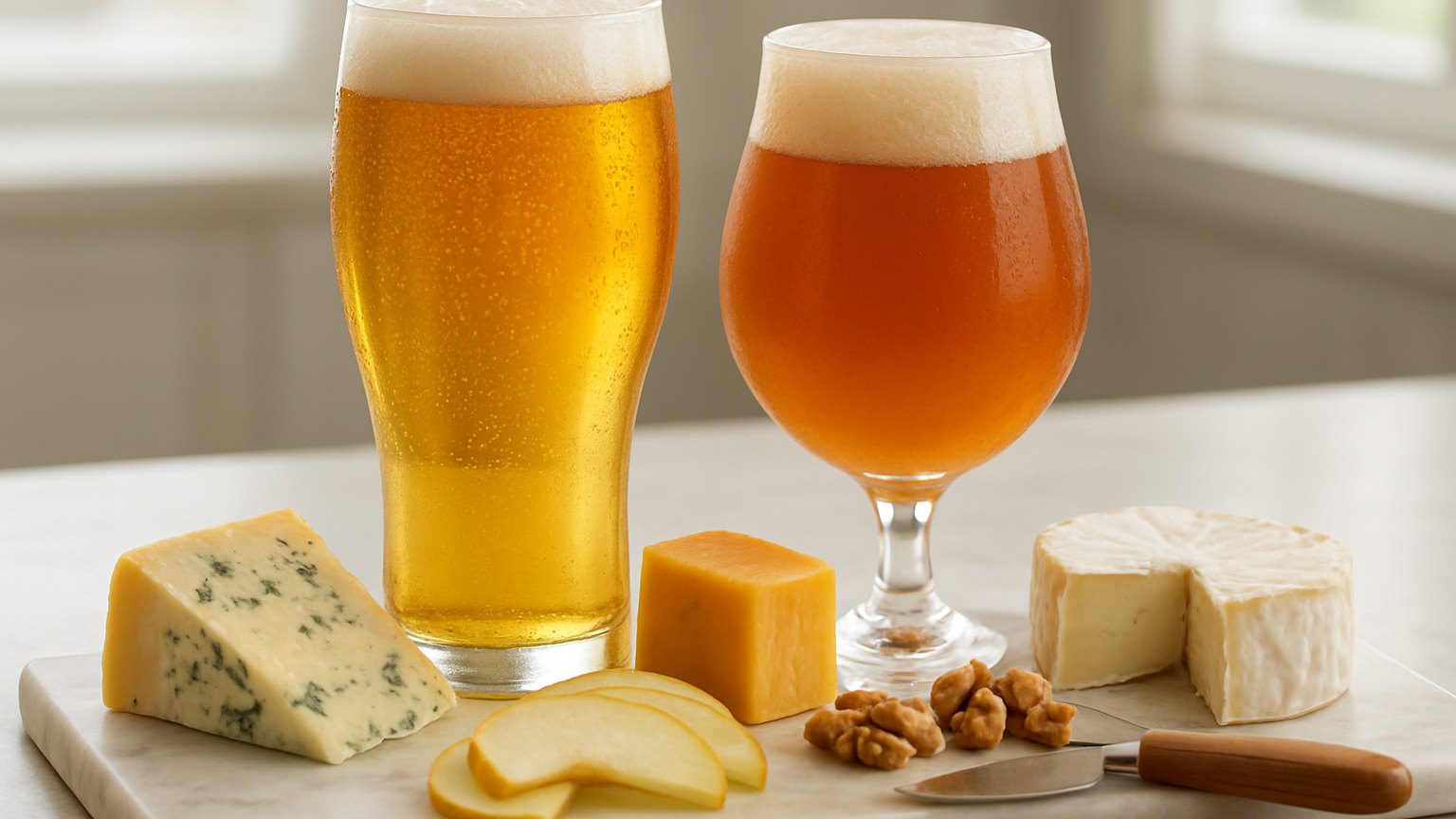
Cheese is traditionally paired with wine and works at least as well with beer, frequently better. Both are fermented, both carry yeast character, and beer has carbonation and bitterness to handle the fat that wine can only address with acidity.
Why does beer work so well?
Three reasons. Carbonation scrubs the fat coating from the palate between mouthfuls. Malt sweetness balances salt, which is present in every cheese. And the shared fermentation character gives the two something in common to build on.
Red wine tannin, by contrast, clashes badly with several cheeses, producing a metallic taste that is a common and underdiscussed problem at the end of a meal.
What goes with hard cheese?
Mature cheddar, gruyère, comté and similar want something with malt depth and enough bitterness to cut through.
- Best bitter or brown ale. Nutty malt against nutty cheese. Excellent.
- Pale ale. Bitterness cuts the fat cleanly.
- Bock. Bready and rich, suits aged alpine cheese.
What goes with blue cheese?
Blue is salty, sharp and intense, and it needs something equally strong with sweetness to balance it.
- Imperial stout. The classic. Roast and residual sweetness against salt and funk.
- Barley wine. Rich and sweet enough to stand up.
- Belgian quadrupel. Dark fruit against blue mould.
This is one of the pairings where beer decisively outperforms most wine, and it is worth trying deliberately.
What about soft and fresh cheese?
Goat’s cheese, mozzarella and young soft cheeses are delicate and acidic, so anything heavy overwhelms them.
Saison, wheat beer, gose or a light pilsner all work. A sour beer with fresh goat’s cheese is particularly good, since the acidity in each meets the other.
What about washed rind cheese?
Epoisses, taleggio and similar are pungent, sticky and assertive. They need a beer with enough character not to disappear.
Belgian dubbel, tripel and strong dark ales all work. Trappist beers and monastery cheeses are a genuine historical pairing rather than a marketing one.
How do you build a board around beer?
Three or four cheeses spanning the range, with two or three beers rather than one:
- A fresh or soft cheese with a saison or wheat beer.
- A hard aged cheese with a bitter or brown ale.
- A blue with an imperial stout.
Serve the cheese at room temperature and the beer cooler than you would drink it alone, since it will warm in the glass.
What should you avoid?
Heavily hopped IPA with most cheese. The combination of high bitterness and cheese fat produces a harsh, metallic finish that neither improves.
There are exceptions, and it is the one pairing worth approaching sceptically despite how often it is suggested.
What order should you taste them in?
Mildest to strongest, in both cheese and beer. A blue cheese eaten early flattens everything after it, and an imperial stout does the same to the beers that follow.
Cleanse between with plain bread or a cracker and a mouthful of water. It makes a genuine difference to how much you can still taste by the third cheese.
How much should you serve?
Around 30 to 50g of each cheese per person, and 100 to 150ml of each beer. Four cheeses and three beers is a comfortable evening for two or three people without anyone losing the ability to distinguish them.
Does the beer need to be strong?
Only for the strongest cheeses. A best bitter at 4.2 per cent handles hard cheddar perfectly well, and it is only blue and washed rind cheeses that genuinely need something at 8 per cent or above.
That matters practically, since a board with three strong beers alongside it adds up quickly. A 330ml bottle of 10 per cent imperial stout is 3.3 units on its own.
Should the cheese or the beer lead?
Whichever you care more about. If you have a beer you want to show off, choose cheese that supports it. If the board is the point, choose beers that flatter it.
Trying to give both equal billing usually produces a compromise that serves neither, which is worth deciding before shopping rather than after.


