
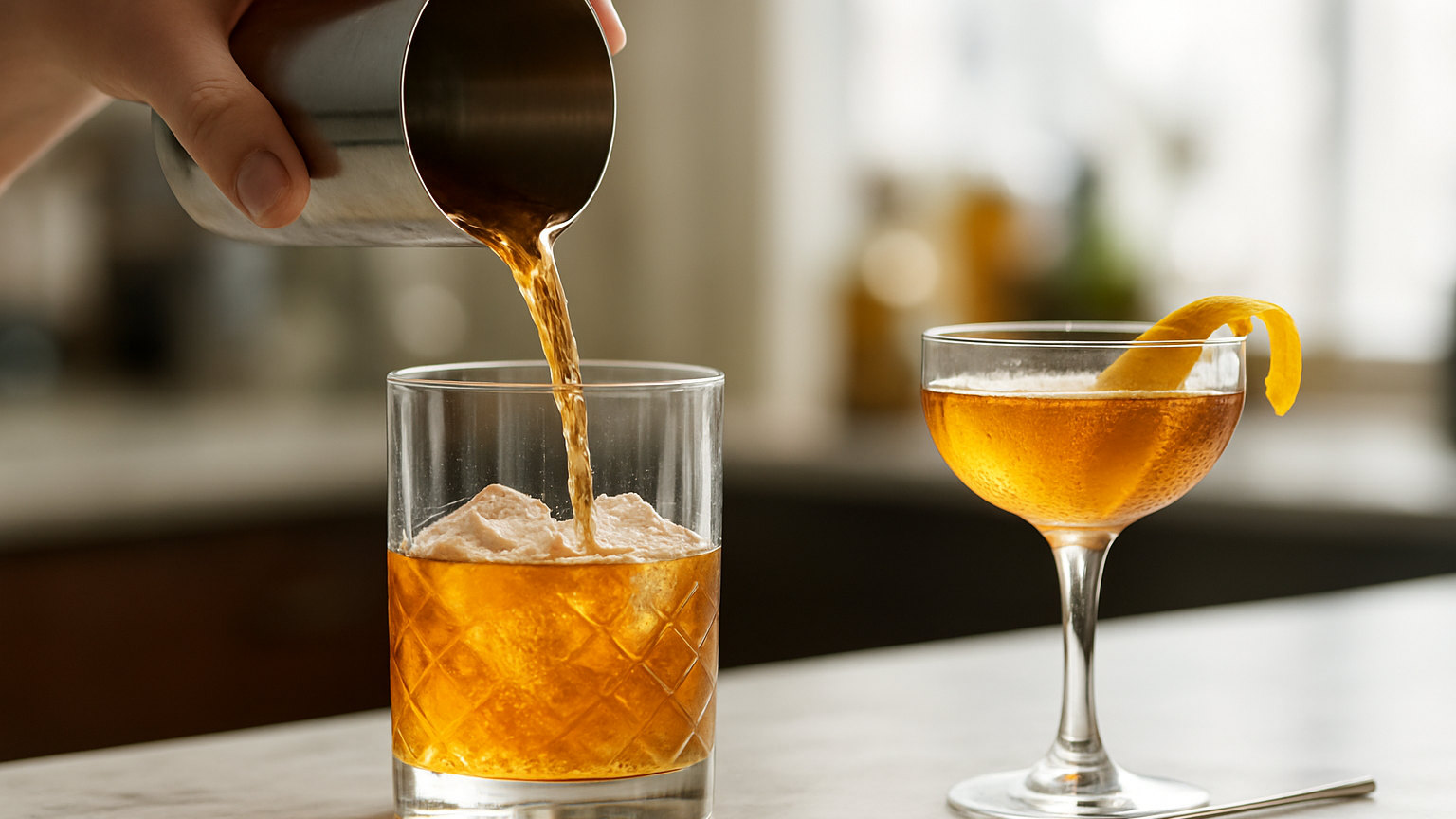
Throwing is the least familiar of the mixing methods and the most theatrical. The drink is poured from one vessel to another from an increasing height, repeatedly, so it travels through the air on the way. It looks like showmanship and it is doing something specific.
What does it achieve?
Aeration without violence. A shake introduces air by forcing ice through liquid at speed, which also fragments the ice and produces a rougher texture. Throwing introduces air by exposing the liquid to it in a long thin stream.
The result sits between shaking and stirring. More aerated than a stirred drink, smoother and less fragmented than a shaken one, and with more controlled dilution than either.
Which drinks suit it?
- Bloody Mary. The classic case. Shaking whips tomato juice pale and frothy; throwing mixes without ruining the body.
- Drinks with sherry or fortified wine. Where a shake would be too aggressive.
- Anything with a delicate texture that still needs more integration than stirring provides.
The technique is strongly associated with Spanish bartending, where it is used routinely for vermouth-based drinks.
What is rolling, and is it the same thing?
Rolling is the gentler relative: pouring back and forth between two vessels held close together, without the height. It mixes and chills without aerating much at all, which is the usual recommendation for a Bloody Mary at home.
Throwing is rolling with distance added, and the distance is what does the aerating.
How do you do it?
- Build the drink with ice in one tin.
- Strain it into the second tin, holding the strainer against the first.
- Raise the pouring tin gradually as the stream establishes, up to arm’s length.
- Catch the stream in the lower tin, keeping it steady.
- Repeat back and forth four or five times.
- Strain over fresh ice.
Start low. Building height comes with practice, and the point is a consistent unbroken stream rather than the distance itself.
Should you try it at home?
Over a sink, and with water first. It is genuinely messy while you learn, and there is no reason to discover that with a drink you have already paid for.
Rolling is the practical version for home use. It achieves most of the benefit for a Bloody Mary with none of the risk, and four or five gentle passes is enough.
Why does it suit a Bloody Mary specifically?
Because shaking aerates tomato juice heavily, which turns it pale, frothy and slightly separated, and breaks down the body that makes the drink satisfying.
Rolling or throwing mixes the seasoning through evenly and chills the drink while keeping it dense and deep red. Stirring alone tends to leave the salt and Worcestershire sauce sitting at the bottom.
Does it dilute differently?
Slightly less than shaking, because the ice is not being fractured. Each pass adds a small amount of melt, and four or five passes lands somewhere between a stirred and a shaken drink.
For a Bloody Mary that is about right, since the drink is already substantial and does not want thinning.
Is it worth learning?
As a technique, it is a niche skill for a handful of drinks. As a way of understanding what aeration does, it is genuinely instructive, because it separates aeration from ice fragmentation in a way nothing else does.
Try rolling a Bloody Mary and shaking another one, side by side. The difference in colour alone makes the argument.
Do you need special equipment?
Two shaker tins and a Hawthorne strainer, all of which you would own anyway. Some bartenders use a dedicated throwing tin with a spout for a cleaner stream, which helps and is not necessary.
Is it worth doing for anything else?
Vermouth served over ice benefits, since it aerates and opens up much as wine does in a decanter. Beyond that and the Bloody Mary, the technique is a niche one, which is why most home bars never need it.


