
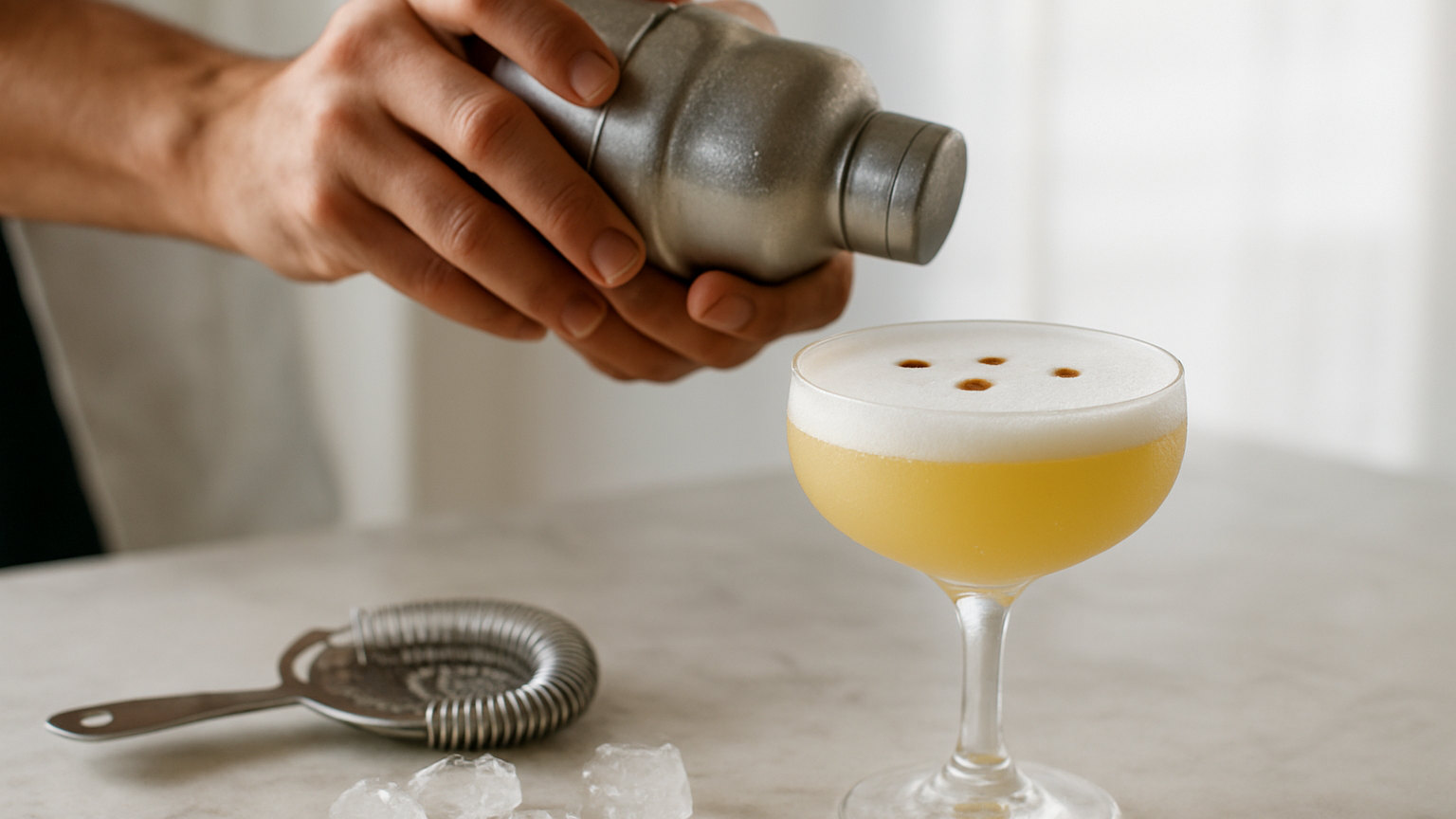
The reverse dry shake inverts the usual order: shake with ice first, strain the ice out, then shake the chilled liquid again without it. Bartenders disagree about whether the improvement justifies the extra step, and it is easy enough to test for yourself.
How does it differ from a standard dry shake?
A standard dry shake goes: shake without ice, add ice, shake again, strain. The foam is built first and then diluted by the second shake.
A reverse dry shake goes: shake with ice, strain into a clean vessel, shake again without ice, pour. The dilution happens first and the foam is built into a mixture that is no longer being watered down.
Why is the foam denser?
Because the final agitation is the one that sets the texture, and in a reverse shake nothing is added afterwards. In a standard dry shake, the foam you built in step one is partially broken down by the ice in step two.
The result is a thicker, more stable head that holds its shape longer and takes a drop of bitters on the surface more cleanly.
Does the cold not inhibit the foam?
Partly, and that is the counterargument. Proteins unfold more readily when warm, so the second shake is working against lower temperatures. In practice the mechanical agitation compensates, and the results are consistently good.
What is the method?
- Combine all ingredients including the egg white or aquafaba in the shaker with ice.
- Shake hard for twelve seconds.
- Strain into the smaller tin or a clean vessel, leaving the ice behind.
- Seal and shake hard again for fifteen seconds with no ice.
- Pour straight into a chilled glass, without straining.
The final pour needs no straining because the ice was removed at the previous stage, which is a small practical advantage.
Is it worth the extra step?
For a single drink where the foam is the point, arguably yes. For four drinks on a Friday evening, most people find the standard dry shake perfectly adequate.
The honest comparison is that both produce a good foam and the reverse produces a slightly better one. It costs an extra vessel to wash and about twenty seconds.
How do you test it?
Make the same drink twice, one each way, and put them side by side. Look at the height of the head after five minutes rather than immediately, since that is where the difference shows.
Doing this once settles the question for your own purposes better than any description, and it takes ten minutes.
What else affects the foam?
- Double straining, if you do strain. Ice shards puncture foam from below.
- A chilled glass. A warm glass melts the base of the head on contact.
- Shake intensity. More important than the order.
- Quantity of egg white. Around 15ml. More is not better.
- Sugar content. Sugar helps stabilise bubbles, so a bone-dry sour foams less.
Of these, shake intensity matters most. A hard standard dry shake beats a gentle reverse one comfortably.
Does it work with aquafaba?
Yes, identically. Aquafaba behaves much like egg white in a shaker, foams well and carries no salmonella risk, which makes it the easier option for anyone serving drinks to guests whose circumstances they do not know.
Which should a beginner use?
The standard dry shake. It is one vessel, one fewer step and it produces a perfectly good foam. Try the reverse once you are shaking hard and consistently, at which point you will be able to tell whether the difference justifies the extra work.
Does it help with aquafaba specifically?
Slightly more than with egg white, in most people’s experience. Aquafaba foam is a little less stable to begin with, so the benefit of building it last, into a mixture that will not be diluted afterwards, shows more clearly.
How long does the foam last either way?
A standard dry shake gives a head that holds for around five minutes. A reverse shake typically holds for eight or ten. Both are longer than it takes to drink a sour, which is a fair argument that the difference is aesthetic.


