
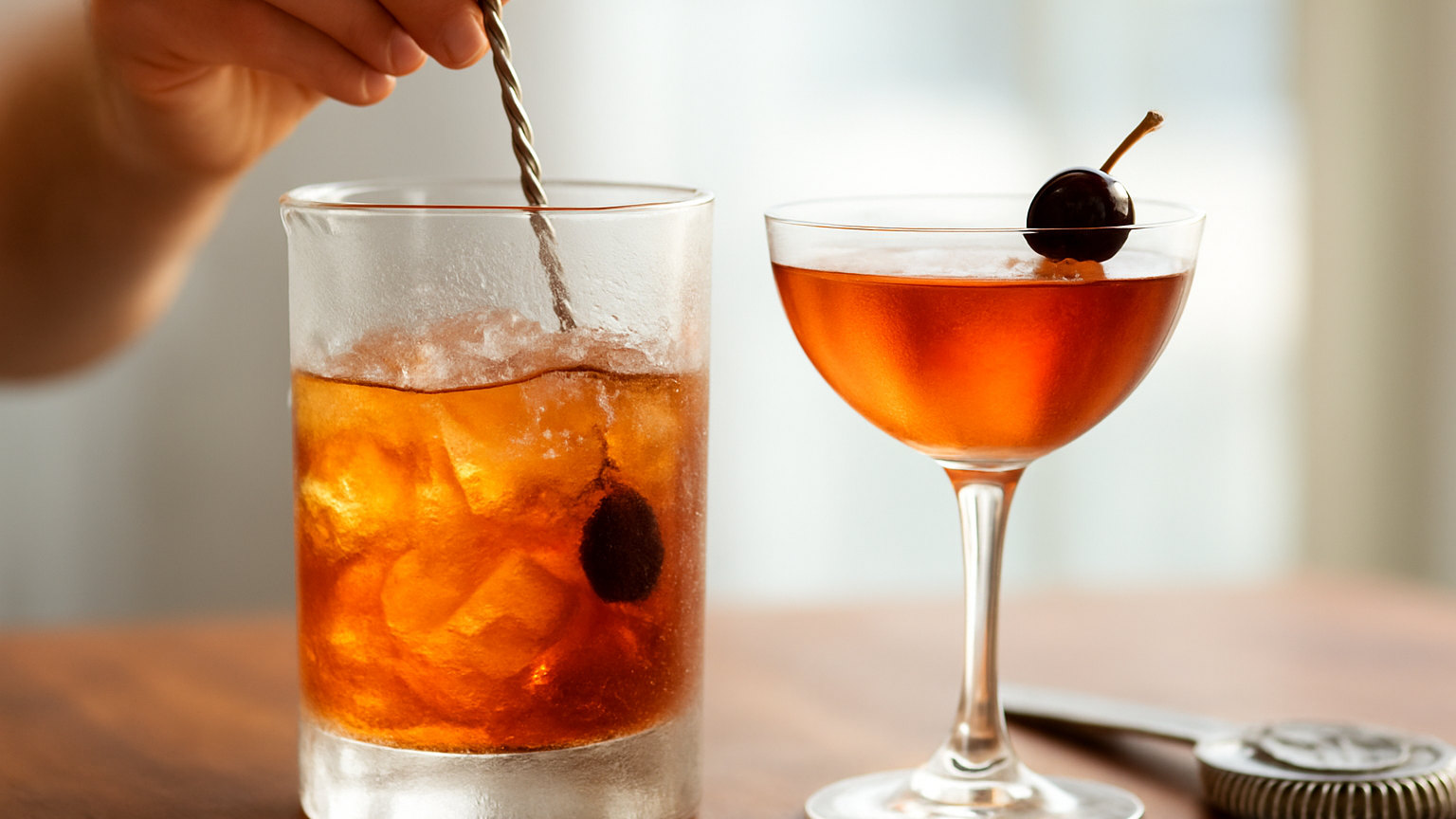
Ask why a home-made Manhattan or old fashioned tastes harsh and the answer is almost always the same. The recipe was right, the spirits were fine, and the stirring stopped about twenty seconds too early. It is the most common and most easily fixed fault in home bartending.
What is the working figure?
Around thirty seconds for a spirit-forward drink stirred with plenty of ice. Some bartenders count rotations rather than seconds and aim for around fifty, which comes to much the same thing.
That is considerably longer than it feels necessary. Most people stop at ten seconds because the glass is cold and the drink looks mixed, and the drink has had less than half the dilution it needs.
How do you tell when it is done?
By touch. Frost forms on the outside of the mixing glass, and when it becomes uncomfortable to hold, the contents are at temperature.
That test is more reliable than counting because it accounts for the variables: how cold your ice was, how much you used, and how warm the glass started. A drink stirred in a pre-chilled glass with freezer-cold ice reaches temperature faster than one in a warm glass with wet ice.
Can you taste it as you go?
Yes, and it is the quickest way to learn what the right point feels like. Draw a little out with a straw or a spoon at fifteen seconds and again at thirty. The difference is much larger than most people expect.
What are you actually adding?
Water. A finished stirred drink should be around 20 to 25 per cent water by volume, and stirring is how it gets there in a controlled way.
An old fashioned made from 60ml of whiskey, a teaspoon of sugar and bitters should leave the mixing glass at around 85ml. If it leaves at 70ml, it has not been stirred enough, and it will taste hot regardless of the recipe.
What does over-stirring do?
Adds more water than the drink wants. Past the point of temperature, the ice keeps melting and nothing else changes.
The result tastes flat and slightly hollow rather than cold. It is a much rarer fault than under-stirring, and the window between the two is wider than people fear, so a few seconds either side will not ruin anything.
Does the ice change the timing?
Considerably. Large, dry cubes straight from a cold freezer chill efficiently and melt slowly, so they give a wide window. Small or wet ice dilutes fast and narrows it.
Fill the mixing glass two thirds to three quarters. Sparse ice warms quickly and dilutes fast, which is why using less ice does not make a less watery drink.
Should the technique change the timing?
Poor technique lengthens it. If the spoon is going through the ice rather than around it, the cubes chip and the drink chills unevenly, so it takes longer to reach temperature and picks up fragments on the way.
Hold the spoon loosely between the middle and ring fingers, keep the back of the bowl against the inside wall, and let the ice rotate as a mass. Done properly it is nearly silent.
Does it differ by drink?
- Martini: 30 seconds. Some prefer slightly less for a colder, sharper drink.
- Manhattan and negroni: 30 seconds.
- Old fashioned: 30 seconds, or longer if you like it softer.
- Anything served over a large cube: slightly less, since a little more dilution follows in the glass.
What if you have no mixing glass?
A pint glass works and so does a large tumbler. Straight sides matter more than the vessel, since the ice needs to rotate cleanly around the wall. The timing does not change.
Can you stir too gently?
Yes, and it is a slower version of the same fault. A very light stir moves the liquid without moving the ice, so the drink chills from the surface of the cubes only and takes far longer to reach temperature. The ice should be rotating as a mass.


