
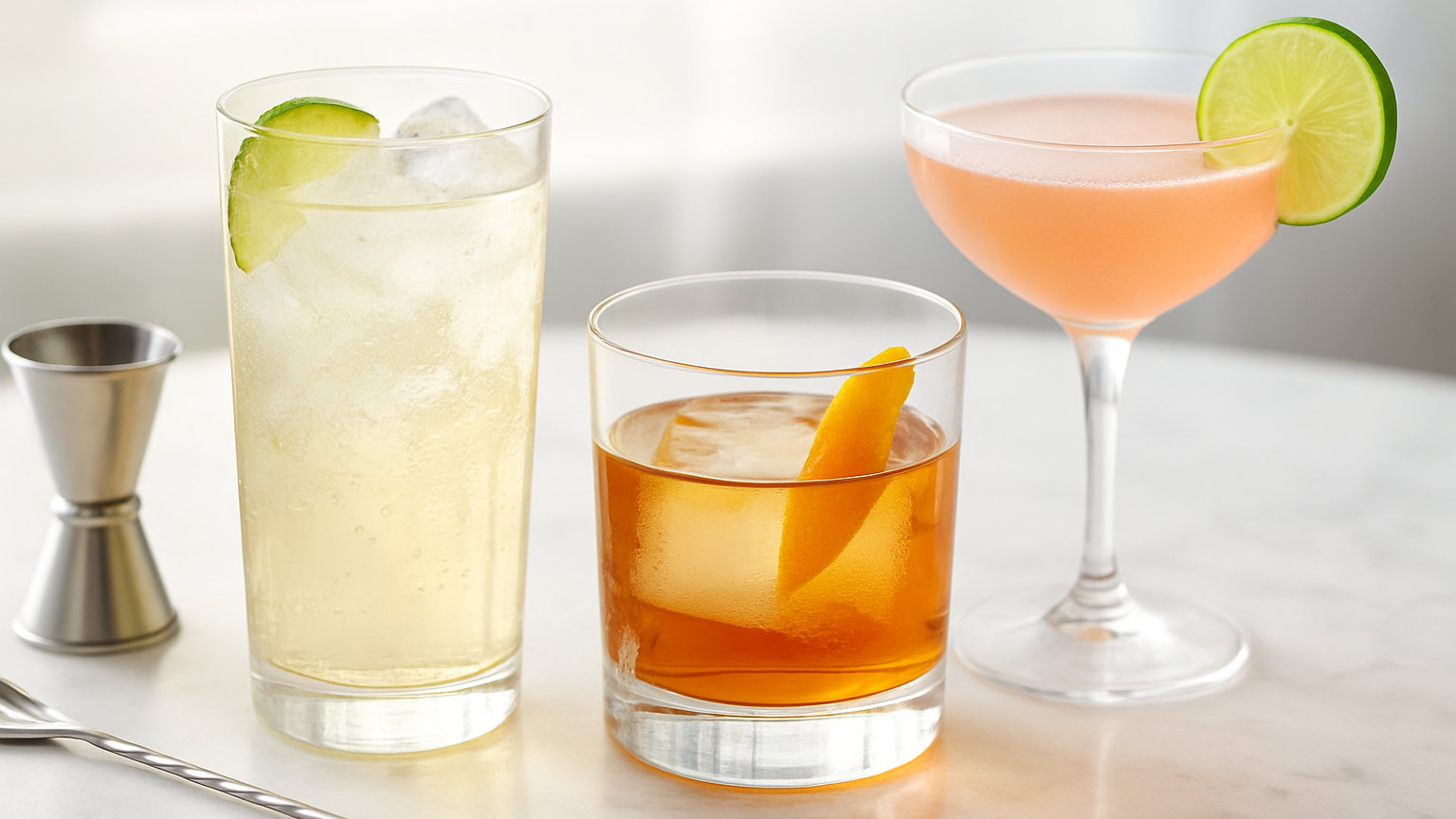
Glassware is where home bars accumulate fastest and least usefully. Shape does genuine work in a drink, and the number of shapes that do different work is small. Three types cover nearly everything, and a fourth is worth adding if you drink spirits neat.
What do the three essentials do?
- Rocks or old fashioned glass. Short and wide, roughly 250 to 300ml. For spirit-forward drinks over ice.
- Highball or collins glass. Tall and narrow, 300 to 400ml. For anything long and carbonated.
- Coupe. Wide and shallow on a stem, 150 to 200ml. For anything served up without ice.
Between them: old fashioned, negroni, whisky and soda, gin and tonic, mojito, daiquiri, martini, sour, cosmopolitan and espresso martini. That is most of a bar list.
Why does the shape matter?
Three reasons, all practical rather than aesthetic.
A narrow glass holds carbonation longer, because there is less surface area for gas to escape from. That is why a highball is tall and thin rather than wide.
A stem keeps your hand off the bowl. A drink served up with no ice has nothing keeping it cold, and holding the bowl warms it noticeably within minutes.
A narrowing or wide shape concentrates or disperses aroma. Since most of what you taste is smell, this changes the drink more than people expect.
Coupe or martini glass?
Coupe, almost always. The V-shaped martini glass has a wide open surface that disperses aroma and it spills at the slightest movement. The coupe holds a similar volume, keeps the aroma above the liquid and stays put on a table.
What size should they be?
Smaller than most shop-bought sets. A coupe at 150 to 200ml suits a 90ml drink after dilution, leaving room without looking mean. Modern glassware runs much larger, which either looks empty or encourages over-pouring.
A rocks glass at 250 to 300ml holds one large ice cube and a 60ml pour comfortably. Anything much bigger tempts a double without anyone deciding to have one.
What is worth adding fourth?
A nosing glass, if you drink spirits neat. A copita or tulip shape narrows at the top and concentrates aroma in a way a tumbler cannot. A small wine glass does almost the same job and most kitchens have one.
After that, a large balloon glass for gin and tonic, which holds more ice and concentrates the botanicals. Useful rather than necessary.
Should you chill glasses?
For anything served up, yes, and it makes a measurable difference. A room temperature glass costs several ice cubes worth of cooling before the drink has started, and a cocktail served up has no ice to maintain it.
Five minutes in the freezer, or a minute filled with ice and water that is then poured off, is enough. It is the cheapest improvement in home bartending and almost nobody does it.
What can wait indefinitely?
- Specialist glasses for one drink. Tiki mugs, julep cups, hurricane glasses.
- Shot glasses. Rarely used for anything worth making.
- Coloured or heavily cut crystal. Attractive and hides the drink.
- Matching sets of twelve. Six of each shape is plenty.
None of this is a reason not to buy them if you like them. It is worth being clear that it is collecting rather than equipping, which is a perfectly good reason on its own.
How should you wash and store them?
By hand where possible, since dishwasher detergent leaves a film that kills the head on anything foamed and dulls the aroma of everything else. Rinse thoroughly and dry with a lint-free cloth.
Store them upright rather than inverted. A glass stored rim down on a wooden shelf traps stale air and picks up the smell of the wood, and a glass that smells of cupboard will taint whatever goes in it. If they have been standing a while, rinse before use.
Six of each shape is plenty for a household that entertains occasionally, and it stacks into less cupboard space than a mismatched dozen.


