
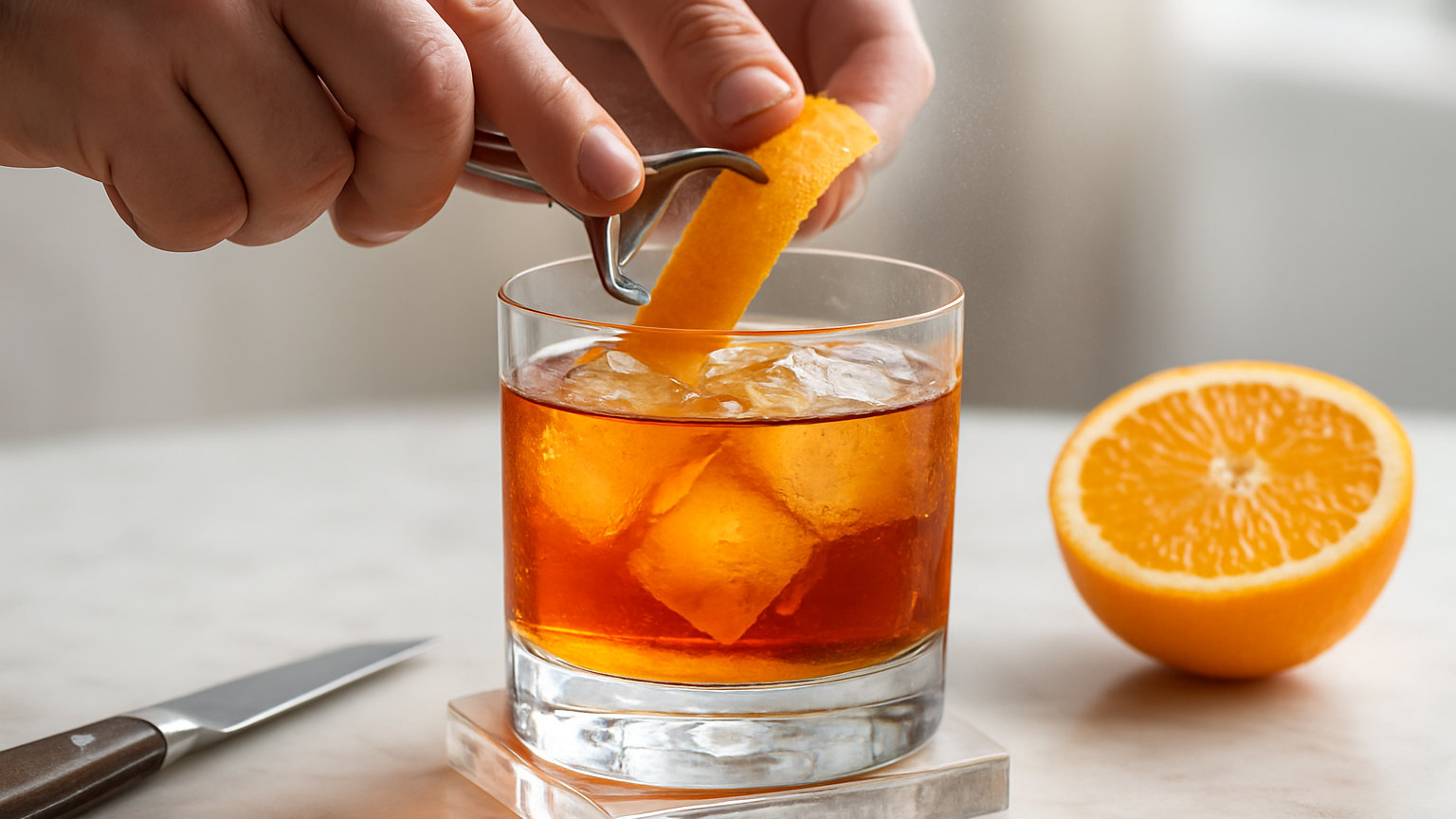
A citrus twist looks like a garnish and functions as an ingredient. Squeezing a strip of peel over a drink releases a fine spray of essential oil that floats on the surface, and since most of what you perceive as flavour is aroma, that layer changes the drink considerably.
How do you cut one?
A vegetable peeler is the right tool, better than a knife or a channel knife for everyday use. Draw it firmly down the fruit to take a strip roughly 4cm long and 2cm wide.
Take as little white pith as you can. Pith is bitter and contributes nothing aromatic, and a twist with a thick white backing will drop bitterness into the drink. If you have taken too much, lay the strip pith side up and scrape it back with a knife.
What does expressing mean?
Squeezing the peel so the oil sprays out. Hold it skin side down, a few centimetres above the surface of the drink, and pinch it sharply between finger and thumb.
You should see a brief mist catch the light. If nothing visible happens, the fruit is old or you are holding it the wrong way round. Skin side down is essential, since the oil glands are in the coloured layer and they spray outwards.
What do you do with it afterwards?
Either rub it around the rim of the glass and drop it in, or discard it. Rubbing the rim puts oil where your lips meet the glass, which reinforces the aroma with every sip.
Dropping it in continues to release a small amount of oil as you drink. Leaving it out gives a cleaner-looking drink with the same initial aroma. Both are legitimate.
Which twist suits which drink?
- Lemon: martini, whiskey highball, Tom Collins, anything gin or whiskey based and served long.
- Orange: old fashioned, negroni, boulevardier, anything with bitters or sweet vermouth.
- Grapefruit: gin drinks with a citrus-forward gin, palomas, anything wanting bitterness as well as aroma.
- Lime: rum and tequila drinks, though lime peel gives less oil than the others.
The rough principle is that orange suits sweeter and darker drinks and lemon suits drier and lighter ones.
Why not just use a wedge?
Because a wedge squeezed into a drink adds juice, which changes the acidity and therefore the balance. That is sometimes what you want, in a gin and tonic or a highball where the extra sourness is welcome.
A twist adds aroma and nothing else. In a carefully balanced cocktail, adding juice you did not account for will push it off, which is why stirred drinks almost always take a twist rather than a wedge.
Does the fruit need to be fresh?
Very much so. Citrus oil is volatile and a lemon that has been in a fruit bowl for two weeks will produce almost no spray. The peel goes leathery and the glands dry out.
Keeping citrus in the fridge extends it to around three weeks, and taking a fruit out twenty minutes before use, or rolling it firmly on a worktop, helps it release more readily.
What about a flamed twist?
Warming an orange peel briefly with a lit match and then squeezing it through the flame caramelises the oils as they land, giving a warmer, slightly toasted aroma. It suits a cosmopolitan or an old fashioned.
Be sensible about it: keep it away from anything flammable, do not attempt it near an open bottle of spirit, and do not do it over a drink someone is already holding.
What if you have no peeler?
A small sharp knife works with a little care. Cut a shallow strip, then trim the pith away from the back. A grater is not a substitute, since zest scattered on a drink gives texture without the concentrated oil spray that makes the technique worth doing.
Does the size of the strip matter?
A wider strip holds more oil and sprays more of it, so err larger rather than smaller. Around 4cm by 2cm is a good working size, and anything much narrower produces a visible garnish that delivers very little aroma.


