
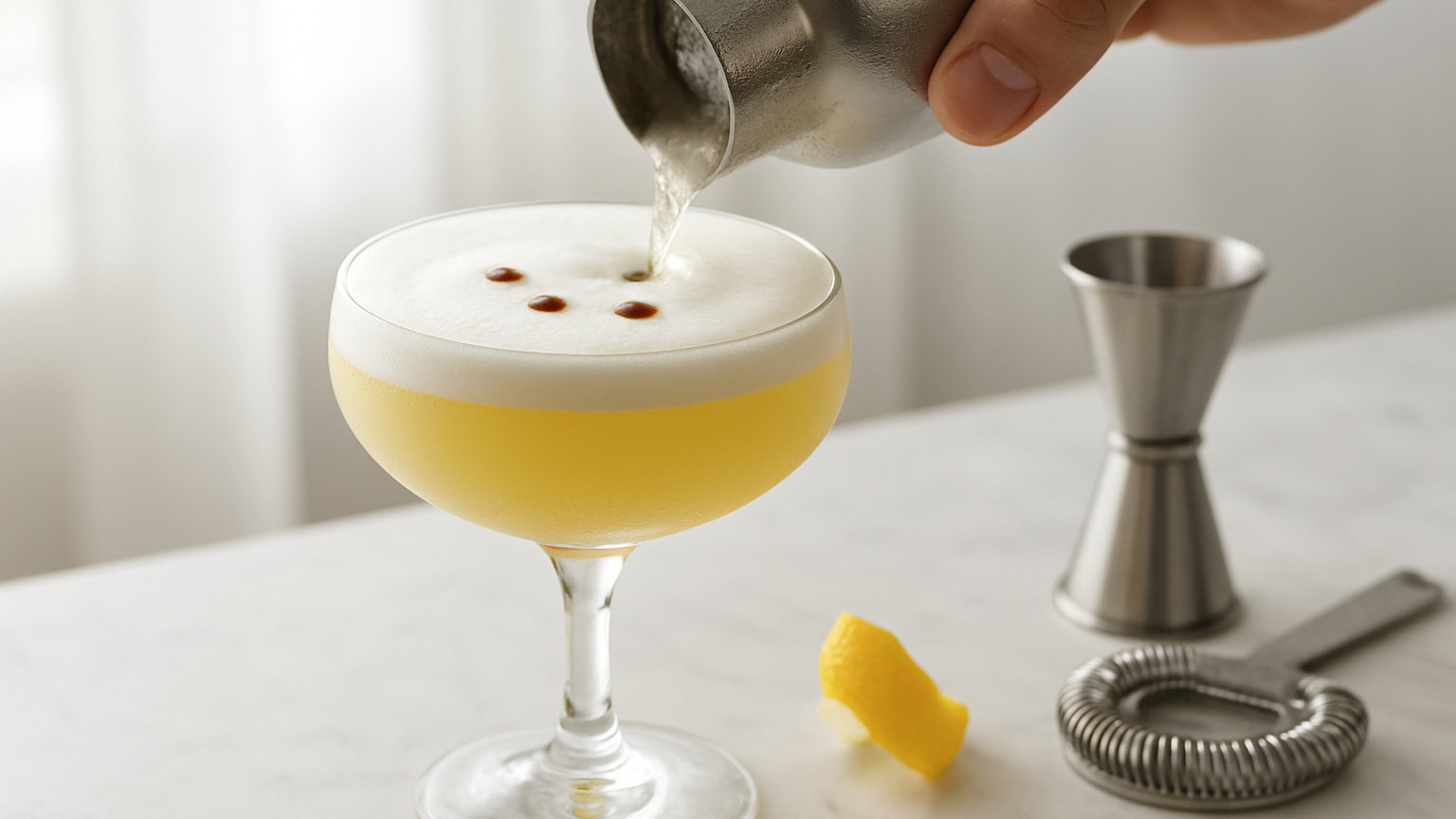
Egg white in a cocktail contributes almost no flavour. What it contributes is texture and appearance: a dense white foam on top and a silky, rounded mouthfeel underneath. Understanding that it is a textural ingredient rather than a flavouring one tells you immediately which drinks want it and which do not.
Which cocktails traditionally use it?
Sours, almost exclusively. The whiskey sour, the pisco sour, the gin fizz, the clover club and the white lady all take egg white, and they share a common structure: a spirit, a sharp citrus element and sugar.
The reason is that citrus makes a drink feel thin and sharp on the palate. Egg white gives it body, softening that sharpness without adding sugar. In a stirred, spirit-forward drink like a martini or an old fashioned there is no sharpness to soften, so egg white would only make things heavy.
What does the dry shake actually do?
A dry shake is a shake without ice, done before the main shake. It matters because cold inhibits the proteins in egg white from unfolding and trapping air. Shake with ice from the start and you get a thin, patchy foam.
The method is straightforward. Combine all ingredients including the egg white in the shaker with no ice. Seal and shake hard for fifteen seconds. Open, add ice, seal again and shake for a further twelve seconds. Then double strain.
Does the reverse dry shake work better?
Many bartenders think so. Shake with ice first, strain the ice out, then shake the chilled liquid again without it. The theory is that the first shake handles dilution and chilling, and the second builds foam into a mixture that is no longer being diluted. The foam tends to be denser and lasts longer.
It is one more step and one more piece of washing up. Try both and decide whether the difference justifies it.
How much egg white should you use?
Roughly 15ml, which is about half a medium egg white. A whole one is too much for a single drink and produces a foam so thick it becomes difficult to drink through.
Separating half an egg white accurately is awkward, so many people crack one into a small jug, whisk it briefly to break it up, and pour from that. This also makes it far easier to scale for several drinks.
Is raw egg white safe to drink?
There is a real if small risk of salmonella from raw egg, and it is not evenly distributed across the population. In the UK, eggs carrying the British Lion mark are produced from vaccinated flocks, and the Food Standards Agency considers them safe to eat raw or lightly cooked, including for vulnerable groups.
Outside that scheme, or outside the UK, the risk is higher. Anyone pregnant, elderly, very young or immunocompromised should be more cautious regardless of the marking, and if in doubt a substitute is the sensible choice. The acidity of the citrus in the drink does not sterilise anything, despite what you may read.
Which substitutes work?
- Aquafaba. The liquid from a tin of chickpeas. Use 20ml. It foams remarkably well and is the closest match, with a faint savoury note that disappears behind the citrus.
- Pasteurised egg white. Sold in cartons. Identical results with the risk removed, and easier to measure.
- Foaming bitters. A few drops of a commercial foamer. Convenient but gives a thinner head.
Aquafaba is the one worth keeping in mind, because most kitchens have a tin of chickpeas and the liquid is usually thrown away. It also makes every one of these drinks suitable for anyone avoiding eggs.
Why does the foam collapse so quickly?
Usually because the shake was too short or the drink was not double strained. Small ice shards falling into the glass puncture the foam from below. Straining through a fine mesh sieve as well as the shaker strainer solves it.
Serving in a chilled glass also helps. A warm glass melts the base of the foam on contact and the whole head starts sinking within a minute.


