
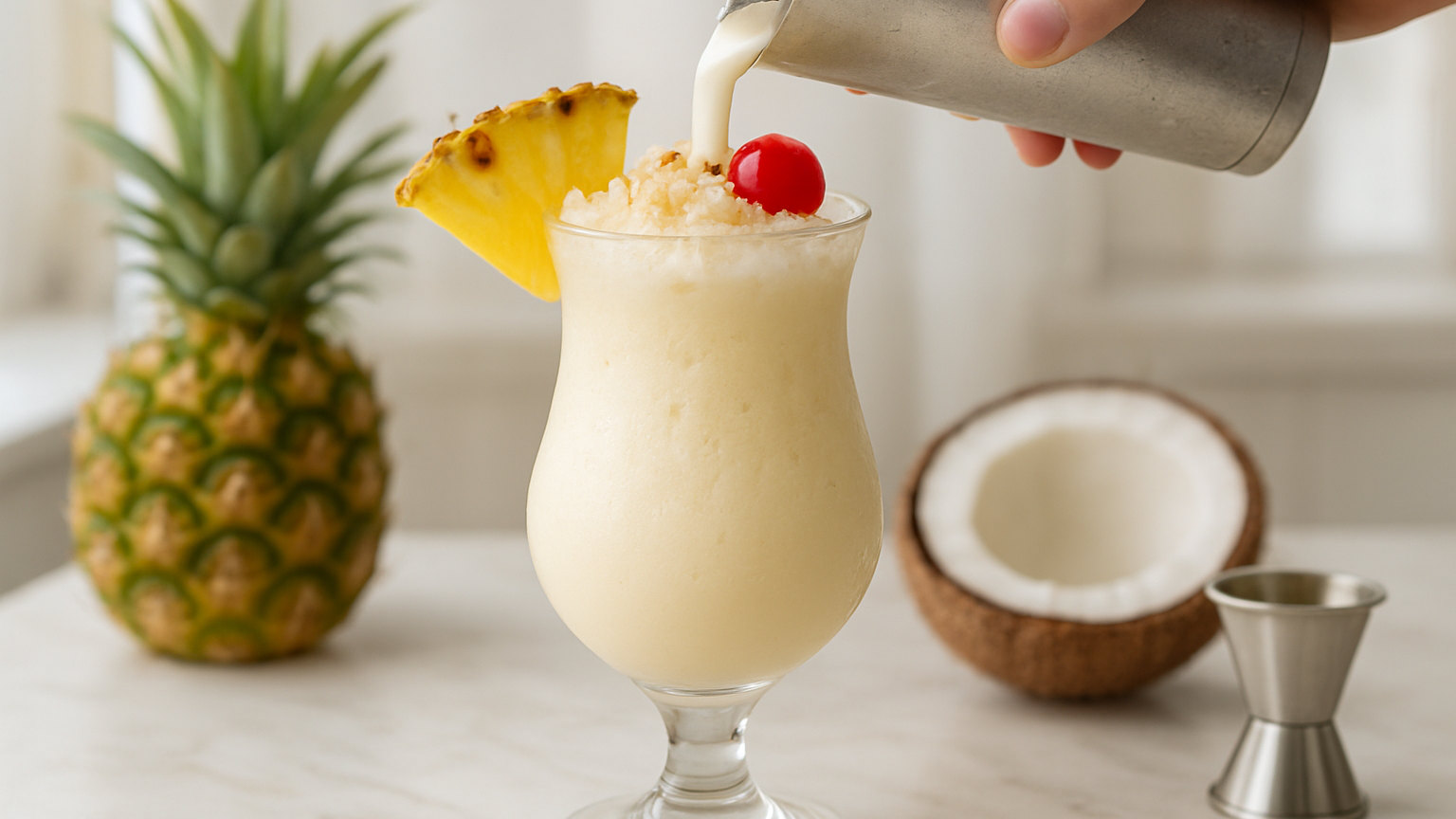
The pina colada is usually presented as a blended drink, but it started life shaken and served over crushed ice, and that version is arguably better. It is certainly easier, quieter and does not require you to own a blender that can handle ice. Both methods are worth knowing, and the ingredients differ slightly between them.
What are the shaken measures?
Sixty millilitres of white rum, 60ml of pineapple juice, 30ml of coconut cream and 15ml of fresh lime juice. Shake very hard with ice for fifteen seconds and strain over fresh crushed ice in a tall glass.
The lime is not traditional and many recipes omit it. Include it. Coconut cream is heavy and sweet, and without acid the drink is cloying by the third mouthful.
What is the difference between coconut cream and coconut milk?
This is the question that causes most confusion, and there are three different products involved:
- Cream of coconut. Sweetened, thick, sold specifically for cocktails. This is what most recipes mean.
- Coconut cream. Unsweetened, thick, sold in tins for cooking. Works well, but you will need to add around 15ml of syrup.
- Coconut milk. Unsweetened and much thinner. Gives a watery drink unless you use considerably more.
If a recipe simply says coconut cream and the result is oddly unsweet, this is why. Check whether yours has sugar in the ingredients list.
Why does the tin need shaking first?
Coconut products separate in the tin, with solid fat at the top and thin liquid below. Pouring straight from an unshaken tin gives you one or the other rather than the mixture you wanted. Shake it hard, or decant and stir, before measuring.
How do you shake it properly?
Harder and longer than a normal cocktail. Coconut fat is thick and does not emulsify easily, and an under-shaken pina colada separates in the glass within a minute, leaving a pale layer on top.
Fifteen seconds at full effort with plenty of ice. The mixture should look uniformly opaque and slightly frothy when you pour it. If you can see streaks of different colours, keep going.
What changes for the blended version?
Use the same measures but add roughly 150g of ice and blend for thirty seconds. Then increase the coconut cream slightly, to around 40ml, and the lime to 20ml.
The reason is that cold suppresses your perception of both sweetness and acidity. A frozen drink made to a shaken recipe tastes noticeably flatter than the same recipe served over ice, and the correction is to push both ends further apart.
Which rum should you use?
Light Puerto Rican or Cuban style white rum is the traditional choice and keeps the drink clean. A useful upgrade is to split it, using 40ml of white rum and 20ml of aged or dark rum, which adds a molasses depth that stands up to the coconut.
Coconut-flavoured rum is generally a mistake here. It doubles up on a flavour already present in quantity and tends to taste synthetic against real coconut cream.
When does it separate, and can you prevent it?
Separation happens as the fat cools and firms. It is normal, and the drink is not spoiled by it. Serving in an opaque or heavily garnished glass hides it, and giving the drink a stir halfway through brings it back together.
A harder shake and a colder serving temperature both delay it. Batching the mix ahead and keeping it in the fridge works well, since a cold base separates more slowly once it hits the ice.
How do you make an alcohol-free version?
Replace the rum with 60ml of additional pineapple juice and add a dash of Angostura bitters if you are not avoiding alcohol entirely, or a pinch of salt if you are. Both restore some of the structure that the rum was providing. This is the drink usually sold as a pina colada mocktail, and it holds up better than most alcohol-free versions of classic cocktails.


