
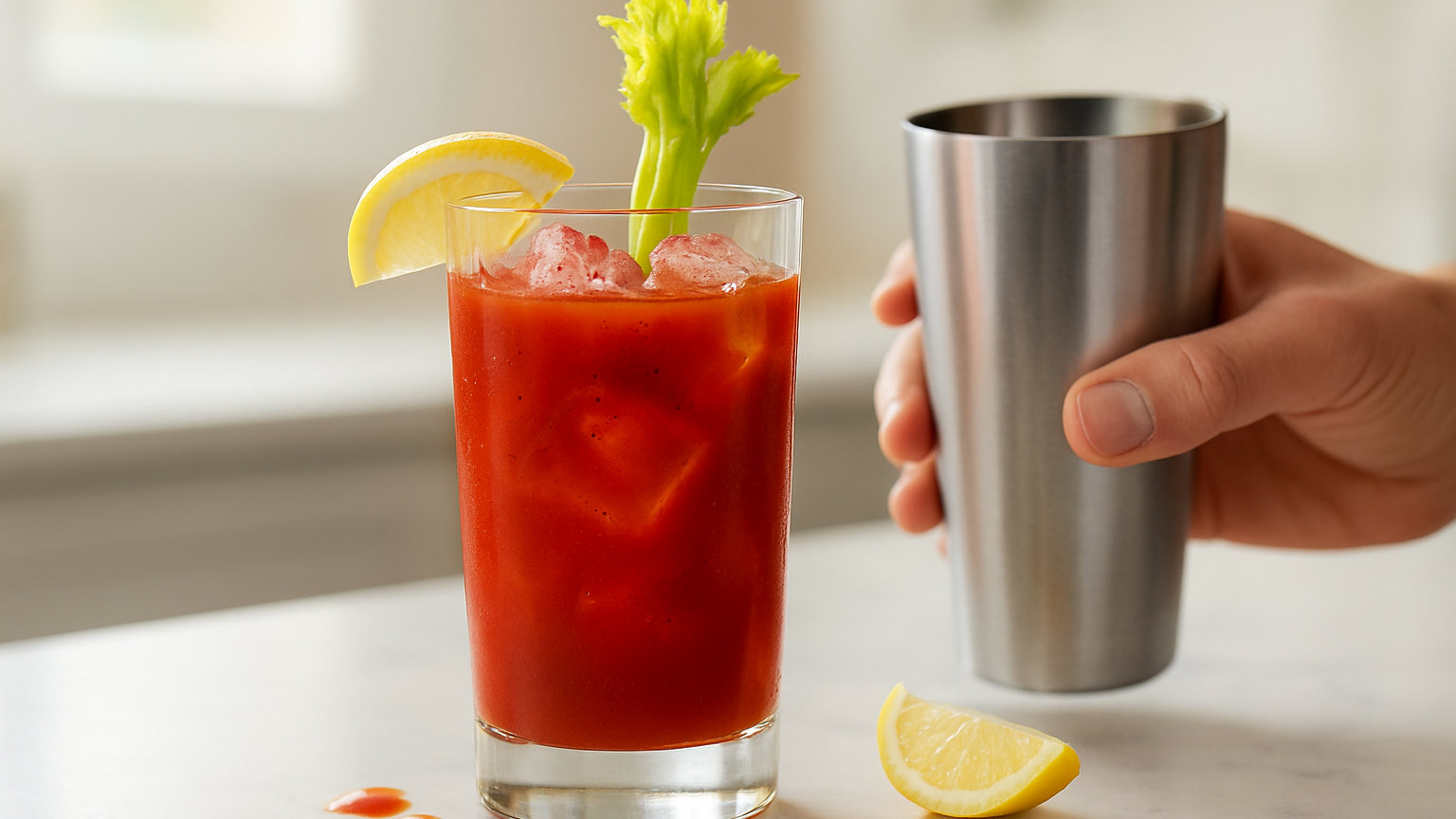
A Bloody Mary has more moving parts than any other standard cocktail, which is why so few of them taste the same twice. It is closer to a cold soup than a mixed drink, and it responds to the same logic: build a base, season in stages, and taste as you go rather than trusting a recipe blindly.
What are the base measures?
Fifty millilitres of vodka, 100ml of tomato juice, 15ml of fresh lemon juice, four dashes of Worcestershire sauce, two dashes of hot sauce, a pinch of celery salt and a good grind of black pepper.
That is the skeleton. Horseradish, sherry, olive brine, smoked paprika and a dozen other additions all have their advocates, and all of them are variations on this base rather than replacements for it.
Why should you roll rather than shake?
Shaking aerates tomato juice, which turns it pale, frothy and slightly separated. It also breaks down the body that makes the drink satisfying.
Rolling means pouring the mixture gently from one tin to another several times, or from a shaker into a glass and back. It mixes and chills without whipping air into it, and the drink stays dense and deep red. Four or five passes is enough.
Can you just stir it?
You can, but the seasoning tends to settle at the bottom and the drink is unevenly salted from top to bottom. Rolling distributes everything properly. If you are building directly in the glass, at least stir thoroughly from the base upwards.
How should you season it?
In this order, tasting between each stage:
- Acid first. Lemon juice. Tomato juice is low in acidity and tastes flat without it.
- Salt second. Celery salt rather than plain salt. It brings a vegetal note that plain salt does not.
- Umami third. Worcestershire sauce. This is what gives the drink its savoury depth.
- Heat last. Hot sauce and black pepper, added a dash at a time.
Adding heat before salt is the usual mistake. Chilli masks your ability to judge seasoning, so you end up with a drink that is hot but underseasoned underneath.
Which tomato juice should you use?
Thickness matters more than brand. A thin, watery juice gives a thin drink that no amount of seasoning will rescue. Look for one where the tomato is the first ingredient and the texture is noticeably viscous.
Check the salt content on the label as well. Some tomato juices are heavily salted already, in which case you will need far less celery salt, and some are unsalted, in which case you will need considerably more.
When does horseradish help?
When you want heat that carries through the nose rather than sitting on the tongue. Chilli heat is felt at the front of the mouth; horseradish is felt higher up and clears faster. Half a teaspoon of grated horseradish is plenty for one drink.
The two work well together in small amounts. Used heavily, either will flatten everything else and you lose the tomato entirely.
How do you scale it for a group?
Make the mix without the vodka and refrigerate it overnight. This is genuinely better rather than merely more convenient, because the seasoning has time to settle and the flavours integrate in a way they do not in a freshly built glass.
For roughly eight drinks: 800ml tomato juice, 120ml lemon juice, two tablespoons of Worcestershire sauce, two teaspoons of celery salt, hot sauce to taste and plenty of black pepper. Pour 100ml of mix over 50ml of vodka in each glass, over ice, and let people season further themselves.
What garnish is worth bothering with?
A celery stick earns its place because it functions as a stirrer and its salinity suits the drink. A lemon wedge lets people adjust the acidity. Everything beyond that is decoration, and the elaborate towers of bacon and cheese are best understood as a photograph rather than a drink.


