
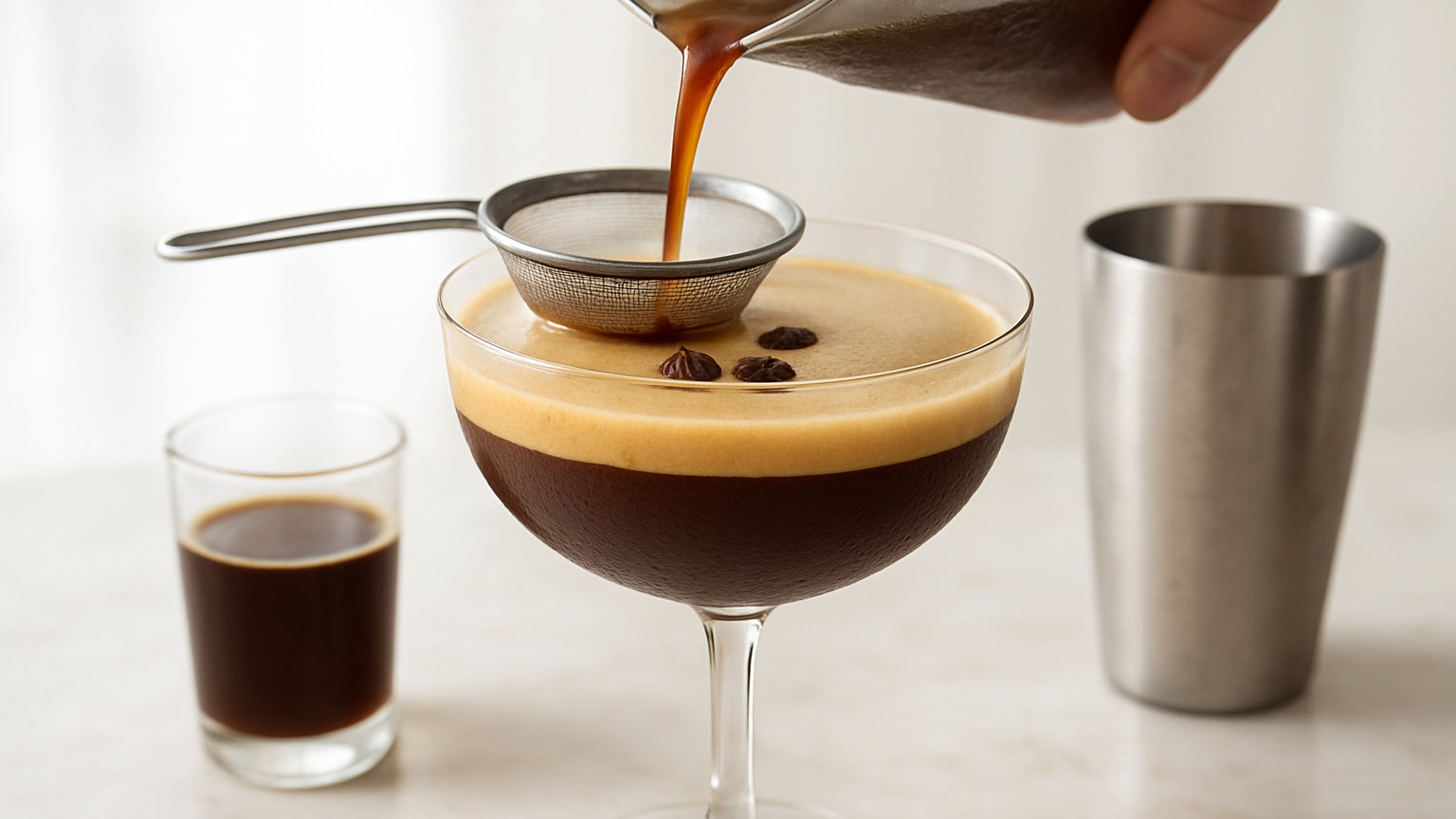
The espresso martini is judged almost entirely on its foam, which is why so many home versions look wrong even when they taste fine. The good news is that the foam has nothing to do with owning an espresso machine. It comes from coffee oils, sugar and a genuinely hard shake, and you can produce all three without any specialist equipment at all.
What is the standard recipe?
Fifty millilitres of vodka, 30ml of coffee liqueur, 30ml of fresh espresso and 10ml of sugar syrup, shaken hard with ice and strained into a chilled coupe. In ounces, that is roughly 1.75oz vodka, 1oz coffee liqueur, 1oz coffee and a bar spoon of syrup.
The syrup is optional and depends on your coffee liqueur, which is already sweet. Taste first. Many bottlings carry enough sugar that the extra syrup tips the drink into dessert territory.
Which coffee can you use instead of espresso?
Several options work, and one of them is arguably better than espresso from a domestic machine:
- Moka pot. The closest match. Strong, oily and concentrated, and it produces good foam.
- Instant espresso powder. Dissolve 2 teaspoons in 30ml of hot water. Genuinely effective, and far more consistent than most home espresso.
- Cold brew concentrate. Use 30ml undiluted. Smoother and less bitter, though the foam is slightly thinner.
- Aeropress. Brew short and strong with a fine grind.
Filter coffee from a cafetiere is the one to avoid. It is too weak and too watery, and the drink ends up tasting like cold coffee with vodka in it.
Why does the foam form, and how do you get it?
Coffee contains oils and dissolved carbon dioxide. Shake it hard with sugar and ice and those oils form a stable emulsion, trapping tiny air bubbles that rise to the surface and sit there as a pale crema layer. Sugar helps the bubbles hold. Fat from the coffee oils does the rest.
The shake needs to be genuinely vigorous, not a polite rattle. Fifteen seconds at full effort, with the shaker held firmly in both hands. You are trying to introduce air, not just chill the mixture. If your arms are not tired you have not shaken hard enough.
Does the coffee need to be hot or cold?
Freshly brewed and still hot gives the best foam, because the oils are more mobile and more gas is dissolved. It also melts more ice, which is fine because the drink needs that dilution anyway. Cold coffee still works and is more convenient, it just gives a shorter-lived head.
How do you get the three coffee beans to float?
They float on their own if the foam is thick enough, which makes them a useful test as well as a garnish. Place them gently on the surface once the drink has settled for a few seconds. If they sink, your foam has not set and the shake was too gentle.
Three beans is the convention, said to represent health, wealth and happiness. There is no flavour reason for them, so leave them off if you would rather.
When should you serve one?
After dinner, and probably not much later than that. A standard espresso martini carries somewhere between 60mg and 100mg of caffeine depending on your coffee, which is roughly a single cup. Two of them late in the evening will keep a lot of people awake.
Anyone sensitive to caffeine, or drinking several across a night, should factor that in alongside the alcohol. The combination of a stimulant and a depressant is easy to underestimate, because the caffeine masks how much you have had.
Can you batch it for a party?
Partly. You can pre-mix the vodka, coffee liqueur, coffee and syrup and keep it cold, but you cannot pre-make the foam. It collapses within minutes and cannot be revived by stirring.
The workable method is to batch the liquid, then shake individual servings to order. That takes fifteen seconds each and still saves most of the effort. Keeping the batch in the fridge also means less ice melt in the shaker, which gives a stronger, better-textured drink.


