
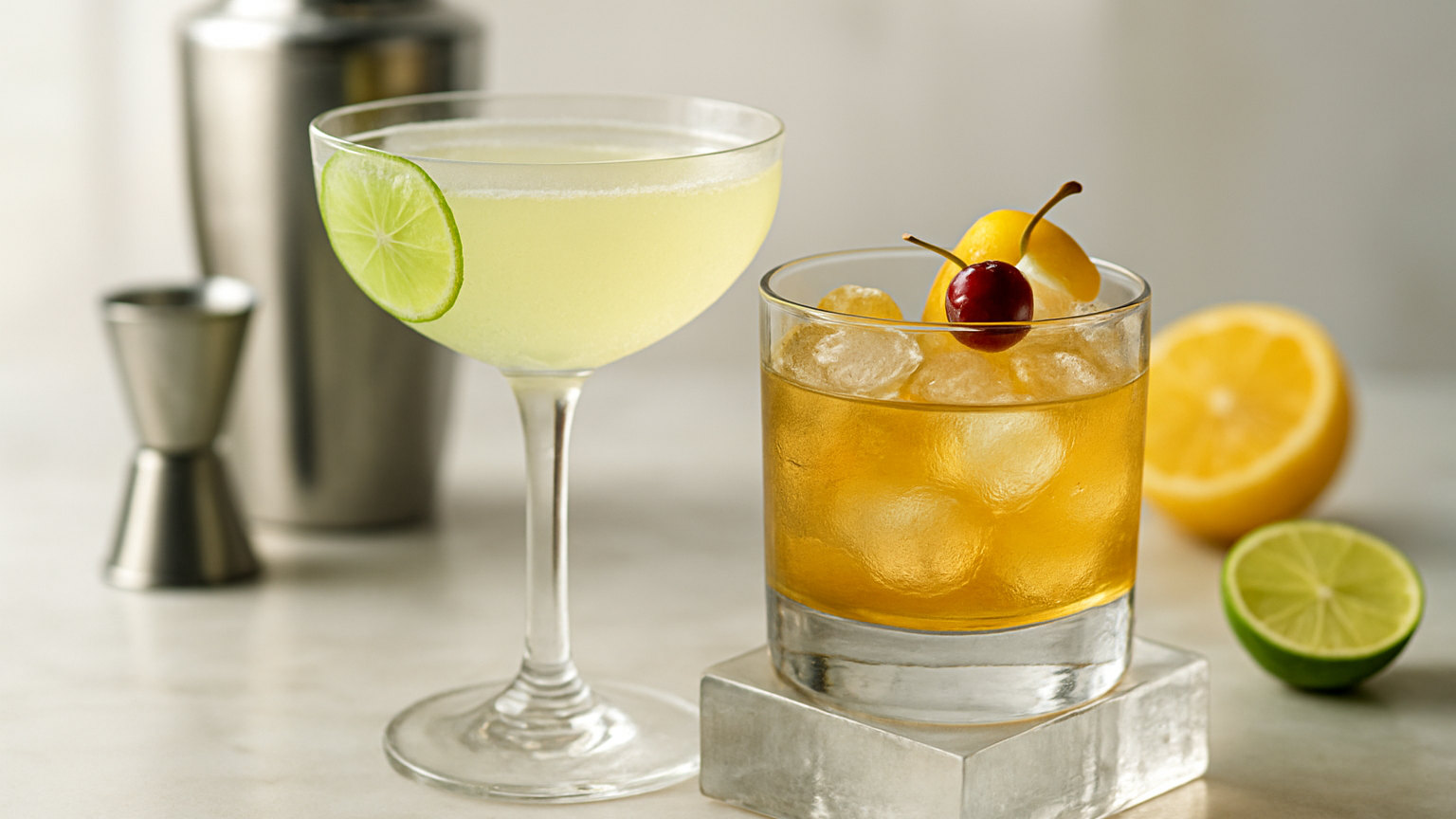
A daiquiri is spirit, citrus and sugar, shaken and served up. So is a whiskey sour, a margarita, a sidecar and a gimlet. They are all built on the same template, which is why learning one properly teaches you most of a cocktail list. The daiquiri is simply the cleanest example, with nothing in it to hide behind.
What is the sour template?
Two parts spirit, one part citrus, one part sugar syrup, adjusted to taste. In practice that means 60ml spirit, 30ml lemon or lime juice and 22ml of simple syrup, though almost every bartender tightens it from there.
Change the spirit and you change the drink’s name. Rum with lime makes a daiquiri. Bourbon with lemon makes a whiskey sour. Gin with lime makes a gimlet. Brandy with lemon and orange liqueur makes a sidecar. The structure underneath never moves.
What are the exact daiquiri measures?
Sixty millilitres of white rum, 25ml of fresh lime juice and 20ml of simple syrup. Shake hard with ice for around twelve seconds and double strain into a chilled coupe. No garnish is necessary, though a lime wheel does no harm.
That is slightly drier than the textbook two to one to one, and it is where most bars have landed. If it tastes sharp, move the syrup up to 22ml before you touch anything else.
Why do bartenders use it as a test?
Because there is nothing in it to disguise a mistake. Three ingredients, no bitters, no dilution beyond the shake, no strong modifier. If the balance is off by 5ml you will taste it immediately. If the rum is poor you will taste that too.
Ordering one is a reasonable way to judge an unfamiliar bar, and making one is a reasonable way to judge your own measuring. If your daiquiris are consistently good, your ratios are sound and everything else on the sour family will follow.
Which rum should you use?
A light, dry white rum is traditional and lets the lime show. Spanish-style rums from Cuba, Puerto Rico and the Dominican Republic suit it particularly well. Aim for 40 per cent or above.
Heavier pot-still rums from Jamaica make a more pungent, funkier daiquiri that some people love and others find overwhelming. Try a blend of half light and half Jamaican if you want to see what the fuss is about without committing entirely.
How does a whiskey sour differ in practice?
Beyond the spirit, two things change. Lemon replaces lime, because lemon suits the sweeter, grain-driven profile of whiskey where lime suits rum. And egg white is frequently added, giving a silky texture and a foam layer that a daiquiri does not usually have.
Whiskey sours also tend to carry slightly more syrup, around 25ml, because bourbon carries more perceived heat than white rum and needs a little more sugar to sit comfortably.
When should you shake and for how long?
Every drink in the sour family is shaken, never stirred. Citrus juice and syrup are heavier than spirit and will not combine properly without agitation, and the aeration is part of the texture.
Twelve to fifteen seconds with plenty of hard, dry ice is the working range. You are looking for the shaker to frost over on the outside. Shaking longer does not improve it; it just adds water past the point the drink wants.
Which adjustments are worth trying?
- Swap simple syrup for demerara syrup to give the drink more body and a molasses note.
- Add 5ml of maraschino liqueur and a bar spoon of grapefruit juice to make a hemingway daiquiri.
- Use half lime and half grapefruit juice for something more aromatic.
- Add two dashes of Angostura on top of a finished daiquiri for depth without changing the balance.
All of these keep the underlying two to one to one structure intact, which is the point. Once the template is in your hands, most of what looks like a long cocktail list turns out to be a short one with variations.


