
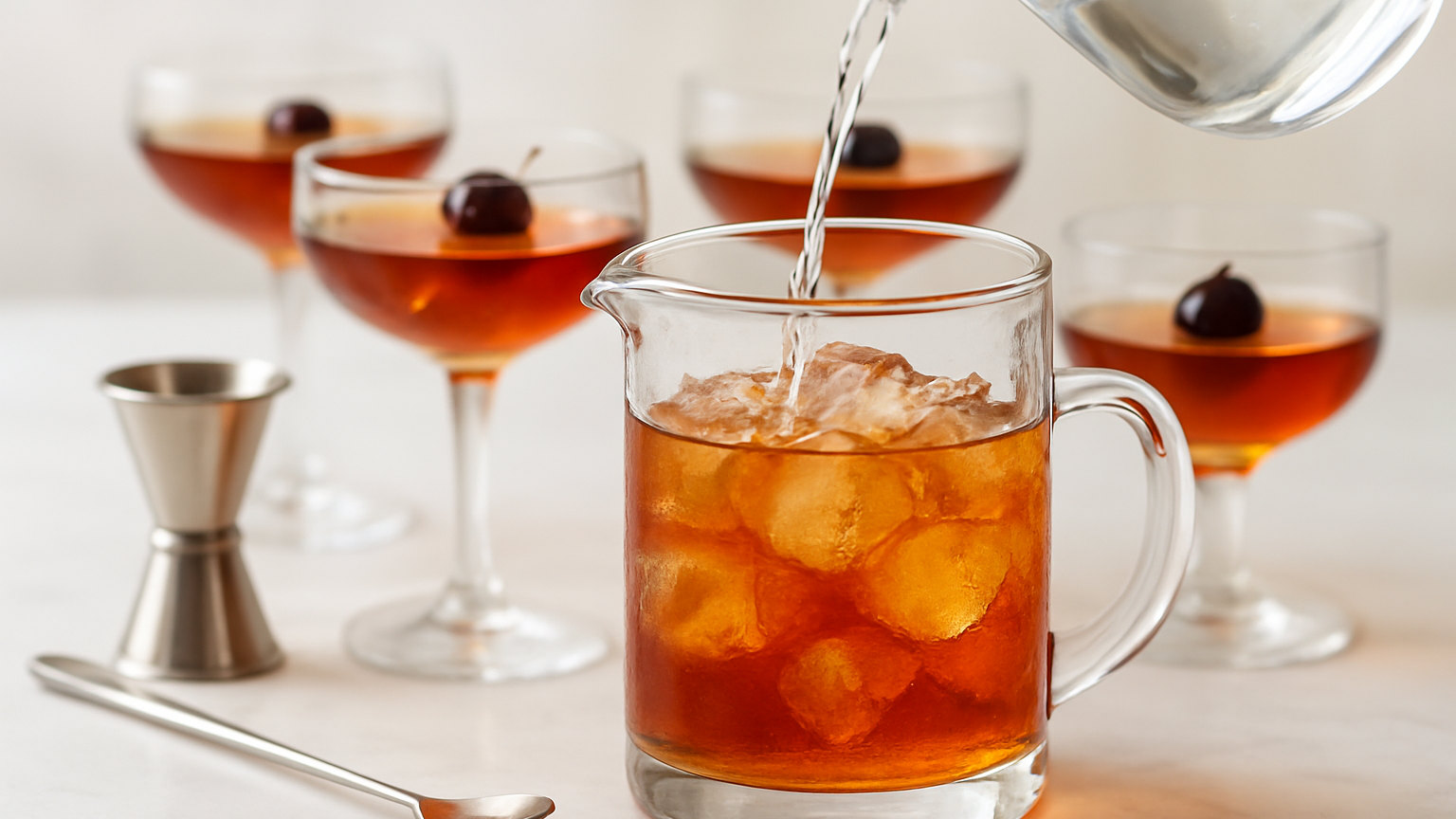
Scaling a cocktail looks like arithmetic and mostly is, with one exception that catches almost everyone. Shaking and stirring do two jobs, chilling and diluting, and a batch skips the second entirely unless you put it back deliberately.
How do you scale up?
Multiply every ingredient by the number of drinks, then add water:
- Stirred drinks: add water equal to around 22 per cent of the total.
- Shaken drinks with citrus: around 25 per cent.
- Long drinks topped with soda: none, since the mixer arrives at serving.
For ten Manhattans: 600ml rye, 300ml vermouth, twenty dashes of bitters, giving 900ml, plus roughly 200ml of water. Chill thoroughly and pour over a large cube.
Why does the water matter so much?
Because the recipe assumes it. A Manhattan leaves the mixing glass at around 110ml from 90ml of ingredients, and that extra 20ml is part of the drink rather than a by-product.
Pour a batch straight over ice and the drink is cold from the ice but has had none of the dilution, so it tastes hot and unbalanced. People usually blame the spirits.
Can you let the ice do it instead?
Partly, and unpredictably. Serving ice melts at a rate you cannot control, so the first glass is under-diluted and the last one is watery. Adding measured water and chilling properly gives a consistent result all evening.
How do you scale down?
Multiply everything by the same fraction, and be aware that very small drinks are harder to make accurately. At half a standard recipe the syrup is 10ml and the citrus 12ml, which needs a graduated jigger rather than estimation.
The shake also changes. A smaller volume in the same shaker with the same ice chills faster and dilutes proportionally more, so shorten the shake by a few seconds.
Which drinks scale well?
- Stirred and spirit-forward: excellent. Manhattans, negronis, old fashioneds and boulevardiers keep for days and improve slightly with a rest.
- Citrus sours: acceptable on the day. Fresh juice dulls within about four hours.
- Anything with soda or sparkling wine: batch everything else and top at the glass.
- Anything foamed: does not scale. The texture is made at the moment of shaking.
What about the bitters?
Scale them like everything else, and measure rather than dashing twenty times into a jug, since dash sizes vary and the error accumulates. Twenty dashes is roughly 16ml, which is easier to pour accurately as a measured quantity.
How should you store and serve a batch?
In sterilised bottles rather than a jug, kept cold in the fridge. Bottles pour cleanly, keep the batch cold and stop it warming on a table.
Spirit-only batches can go in the freezer without freezing solid and are excellent poured neat over one large cube. Anything containing citrus juice should stay in the fridge, since juice will freeze.
What should you label?
The drink, the date and whether it contains alcohol. A batched cocktail and its alcohol-free equivalent look identical in a fridge, and someone avoiding alcohol is entitled to know which is which before pouring.
How much should you make?
Two drinks per person for the first hour and one an hour after that is a reasonable planning figure. Over-cater on mixers and ice rather than on the batch, since leftover spirit keeps indefinitely and leftover mixed cocktail does not.
How do you test a batch before the day?
Make one drink to the batch specification, including its share of the added water, and taste it. Scaling up an untested batch is how twenty drinks end up wrong at once.
Fifteen minutes the day before is cheap insurance against a jug nobody wants to finish.
What about scaling for one very small drink?
Halving works down to about 45ml of spirit, below which measuring becomes the limiting factor. A quarter-sized cocktail needs 5ml of syrup, which is a bar spoon and hard to judge precisely against 6ml.


