
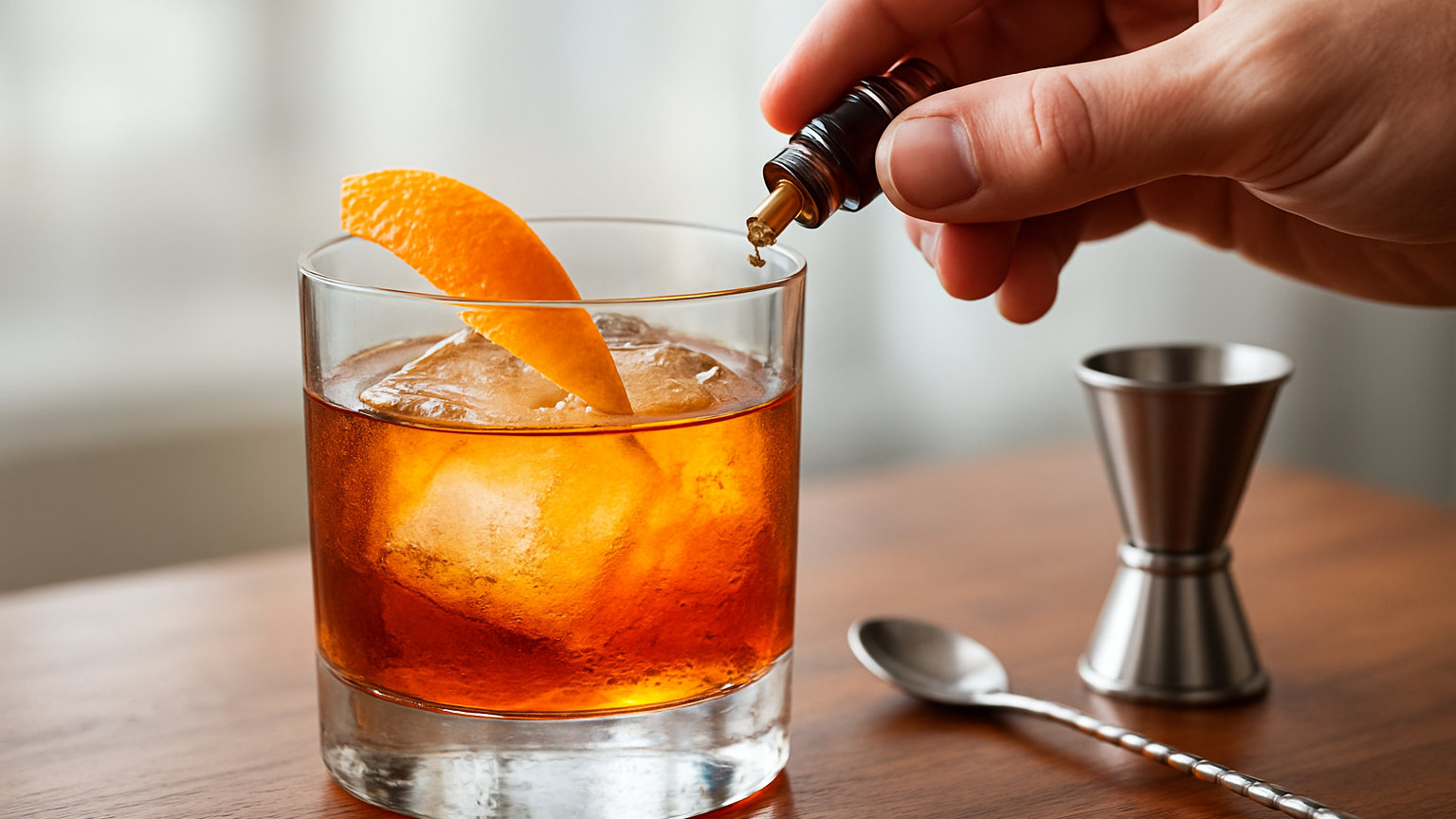
Bitters are the seasoning of a cocktail, and like salt in cooking the quantity is small and the effect is not. A dash is a real unit rather than a shrug, and knowing roughly what it amounts to makes recipes reproducible.
How much is a dash?
Roughly 0.8ml from a standard dasher top, delivered by one firm downward flick of the wrist. Some sources put it slightly under 1ml, and the practical figure is somewhere between 0.6 and 1ml depending on the bottle.
Two dashes is therefore around 1.6ml, which in a 90ml cocktail is under 2 per cent of the volume. That is a small quantity doing a large amount of work.
How does the dasher top work?
It is a restrictor with a small hole and an air channel. Inverting the bottle and flicking it sharply delivers a controlled amount, and the air channel lets the bottle refill so the next dash matches.
Pouring slowly rather than flicking gives an uncontrolled dribble that can easily be three or four times a dash. The sharp flick is what makes the measure consistent.
Why do bottles vary?
Because dasher hole sizes are not standardised. A bottle with a wider hole delivers more per flick. If you switch brands and a familiar drink suddenly tastes different, this is worth checking before blaming anything else.
Calibrate yours once: count dashes into a jigger until you reach the 5ml line. If it takes six, your dash is around 0.8ml. If it takes four, it is closer to 1.2ml and recipes will need adjusting.
What if the bottle has no dasher?
Some bitters are sold with a dropper or a plain cap. A dropper delivers roughly 0.05ml per drop, so a dash is around fifteen drops, which is tedious.
Dasher tops are sold separately and fit most standard bottle necks. It is worth buying one rather than counting drops.
What does a dash actually contribute?
Aromatic complexity and a bitter edge that stops a sweet drink tasting flat. Bitters are concentrated botanical extracts, typically at 35 to 45 per cent alcohol, so a tiny volume carries a great deal of flavour.
The effect is most obvious by subtraction. Make an old fashioned without bitters and it tastes like sweetened whiskey. Add two dashes and it becomes a drink.
How much alcohol does that add?
Two dashes of a 44 per cent bitters is roughly 0.7ml of pure alcohol, which in a 200ml drink works out at around 0.35 per cent by volume.
That is negligible for most purposes and it is not nothing for anyone avoiding alcohol completely. Alcohol-free bitters using glycerine rather than spirit are available, and it is worth mentioning when serving a drink described as alcohol free.
How many dashes should you use?
- Old fashioned: 2 to 3 dashes.
- Manhattan: 2 dashes.
- Sazerac: 3 to 4 dashes of Peychaud style.
- On top of a foam: 2 to 3 drops, for aroma and appearance.
- In a long drink: 2 to 4, since there is more volume to season.
Can you use too many?
Yes, and the result is medicinal and drying. Bitters carry tannin and gentian, and past a certain point the drink tastes like a herbal tincture rather than a cocktail.
Start at the low end of a recipe and add rather than subtract, since removing them is impossible. As with salt, it is easier to correct upwards.
How should you store the bottle?
Upright, at room temperature, out of direct sunlight. Bitters are high in alcohol and keep for years, so there is no need to refrigerate them.
Rinse the dasher top occasionally, since dried residue narrows the hole and gradually reduces the size of a dash without you noticing.
Are all bitters the same strength?
No. Most aromatic bitters sit between 35 and 45 per cent, and some orange and speciality bitters are considerably lower. That affects how much alcohol a dash contributes rather than how much flavour, which is governed by the extract concentration.


