
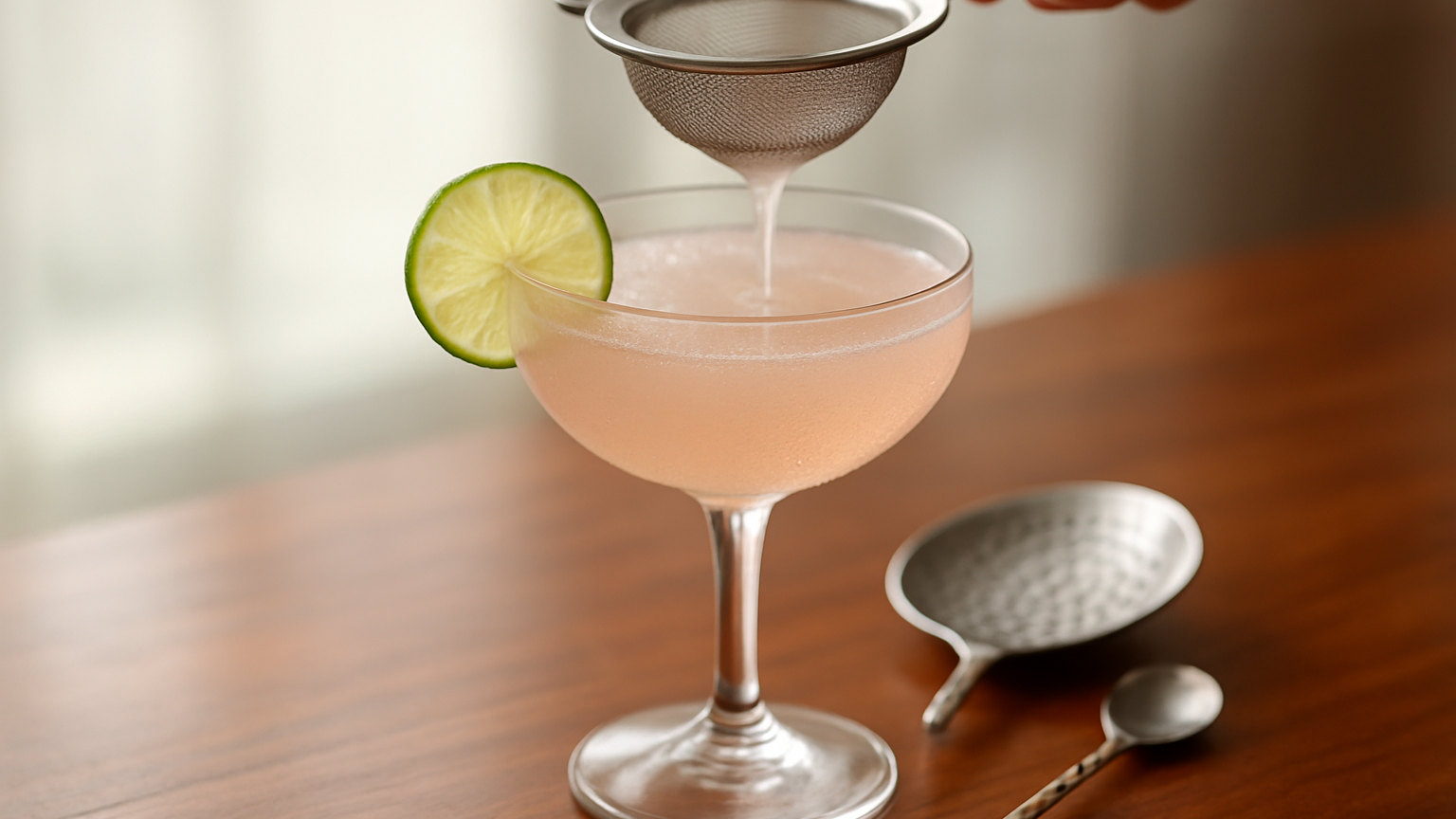
Straining sounds like a single operation and it involves three different tools depending on what you are holding back and what you are pouring into. Getting it right is the difference between a clean cocktail and one with ice shards floating in it.
What are the three types?
- Hawthorne. Flat disc with a coiled spring around the edge and a handle. Sits inside a shaker tin.
- Julep. Perforated bowl on a handle. Sits inside a mixing glass.
- Fine mesh. A small sieve, held in the other hand.
When do you use a Hawthorne?
With a shaker. The spring is the working part: it sits against the inside wall of the tin and catches ice fragments, fruit pulp and herb pieces while the liquid passes through.
Push the gate forward with your finger and the spring tightens against the rim for a finer strain. Pull it back and the gap widens, which lets more through and is useful when you want a little texture.
Which way round does it sit?
Spring downwards, inside the tin, with the handle over the rim. Fitted upside down it does not seal against the wall and ice pours straight past it, which is a common and confusing first mistake.
When do you use a julep strainer?
With a mixing glass, for stirred drinks. It is a shallow perforated bowl that sits at an angle inside the glass, held in place with your thumb.
A stirred drink has large ice cubes rather than shaken fragments, so there is much less to hold back. The julep is a simpler tool for a simpler job, and it originally existed to keep crushed ice out of the drinker’s face rather than as a strainer at all.
A Hawthorne will do this job perfectly well, which is why the julep is the most skippable of the three.
What is double straining?
Pouring through a Hawthorne and a fine mesh sieve at the same time. Hold the sieve over the glass in one hand and pour through both.
The Hawthorne catches the large material and the mesh catches everything else: tiny ice shards, citrus pulp, mint fragments and the fine sediment from muddled fruit.
When does double straining matter?
- Anything served up, without ice. Shards are immediately visible and they dilute the drink further in the glass.
- Anything with egg white or aquafaba. Shards puncture the foam from below and it collapses.
- Anything with muddled fruit or herbs. Otherwise you get bits.
It does not matter for a drink poured over fresh ice, since a few shards disappear into the ice anyway.
What can the kitchen replace?
The fine mesh strainer entirely, since a small tea strainer or sieve does exactly the same job. The julep, since a Hawthorne covers it.
The Hawthorne is the one worth buying. Nothing in a kitchen seals against the wall of a shaker tin the way the spring does, and pouring a shaken drink through a sieve alone is slow and messy.
How do you keep them clean?
Rinse immediately after use rather than at the end of the evening. Citrus and syrup dry hard, and the coiled spring on a Hawthorne is difficult to clean once anything has set in it.
The spring can be unhooked and removed on most models for a proper wash, which is worth doing occasionally. A mesh strainer benefits from a brush, since pulp lodges in the weave and is not removed by rinsing alone.
Do you need a strainer at all?
Only if you shake or stir with ice, which covers most cocktails. Built drinks, made in the glass you drink from, need nothing. A cobbler shaker also has a strainer built into the lid, which is its main advantage.
Which should you buy first?
The Hawthorne, and it is one of the two tools genuinely worth buying rather than improvising. The fine mesh is already in most kitchens as a tea strainer, and the julep is redundant if you own a Hawthorne.


