
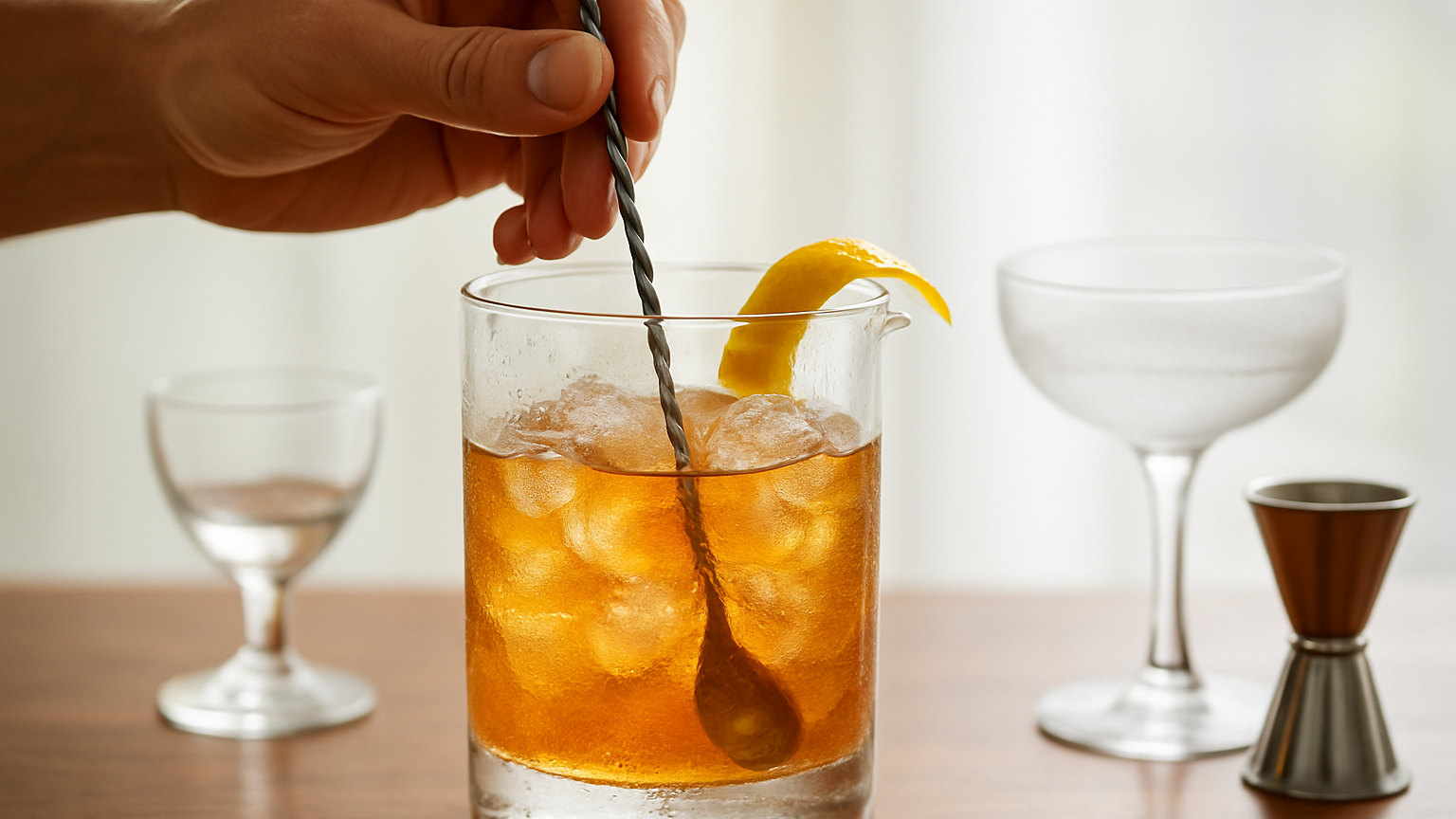
A bar spoon looks like an ordinary long spoon with a decorative twist. The twist is functional, the length is functional, and the shape of the far end usually is too. Once you know what each part does, the tool makes considerably more sense.
Why is the handle twisted?
Because it lets the spoon rotate smoothly between your fingers while the bowl travels around the inside wall of the glass. You hold it loosely, and the spiral slides through your grip as your hand moves.
A straight-handled spoon has to be pushed around the glass, which drags the ice through the liquid and chips it. The twist allows the spoon to move around the ice rather than through it, which chills the drink without over-diluting it or producing shards.
How do you actually stir with one?
- Hold the handle loosely between the middle and ring fingers, not in a fist.
- Rest the back of the spoon bowl against the inside wall of the glass.
- Move your fingers back and forth so the spoon travels around the wall.
- Keep the bowl in contact with the glass throughout.
The ice should rotate as a mass rather than tumbling. Done correctly it is nearly silent. If it sounds like a milkshake being made, the spoon is going through the ice rather than around it.
How long should you stir?
Around thirty seconds for a spirit-forward drink, until the outside of the glass is uncomfortably cold to hold. Most people stop after ten seconds, which is the most common reason a home Manhattan or old fashioned tastes raw.
What is the flat or teardrop end for?
Layering. Hold the spoon so the flat disc or teardrop sits just above the surface of the drink, and pour the liquid slowly onto it. The liquid spreads across the disc and settles gently rather than plunging in.
That is how a float sits on top of a drink: cream on an Irish coffee, a smoky whisky float on a penicillin, red wine on a New York sour. It works because the poured liquid arrives with almost no downward momentum.
Can it be used as a measure?
Roughly. A standard bar spoon holds about 5ml, the same as a metric teaspoon, and recipes calling for a bar spoon of something usually mean that.
Spoon volumes vary between manufacturers, so for anything where accuracy matters use a jigger or a proper teaspoon. For a bar spoon of syrup in an old fashioned, the spoon is fine.
What else does it do?
- Lifting a built drink. One gentle lift from the bottom to distribute syrup without knocking out carbonation.
- Retrieving a garnish from the bottom of a tall glass.
- Muddling gently, using the back of the bowl, when nothing better is to hand.
- Cracking ice, with the back of a heavy one.
What length should it be?
Around 30cm for general use, which reaches the bottom of a mixing glass and most tall glasses. A 40cm version suits very tall glasses and is unwieldy for anything else.
Weight matters more than people expect. A spoon with some heft moves more smoothly and feels controlled; a very light one flexes and skips against the glass.
What can you use instead?
The handle of a long wooden spoon works for lifting and for gentle muddling. A chopstick stirs a tall glass adequately. Neither reproduces the rotating action, so stirred drinks will take longer and pick up more ice fragments.
It is one of the cheaper bar tools, so if you make stirred drinks with any regularity it is worth buying rather than improvising.
Which end should you buy?
A teardrop or flat disc rather than a decorative fork or a muddling head. The disc is what makes layering possible, and the muddler heads on cheap spoons are too small to press anything effectively.
Does it need to be stainless steel?
Yes. Plated spoons lose their coating with washing, and once the plating goes the base metal is exposed to acid and alcohol. Plain steel lasts decades.


