
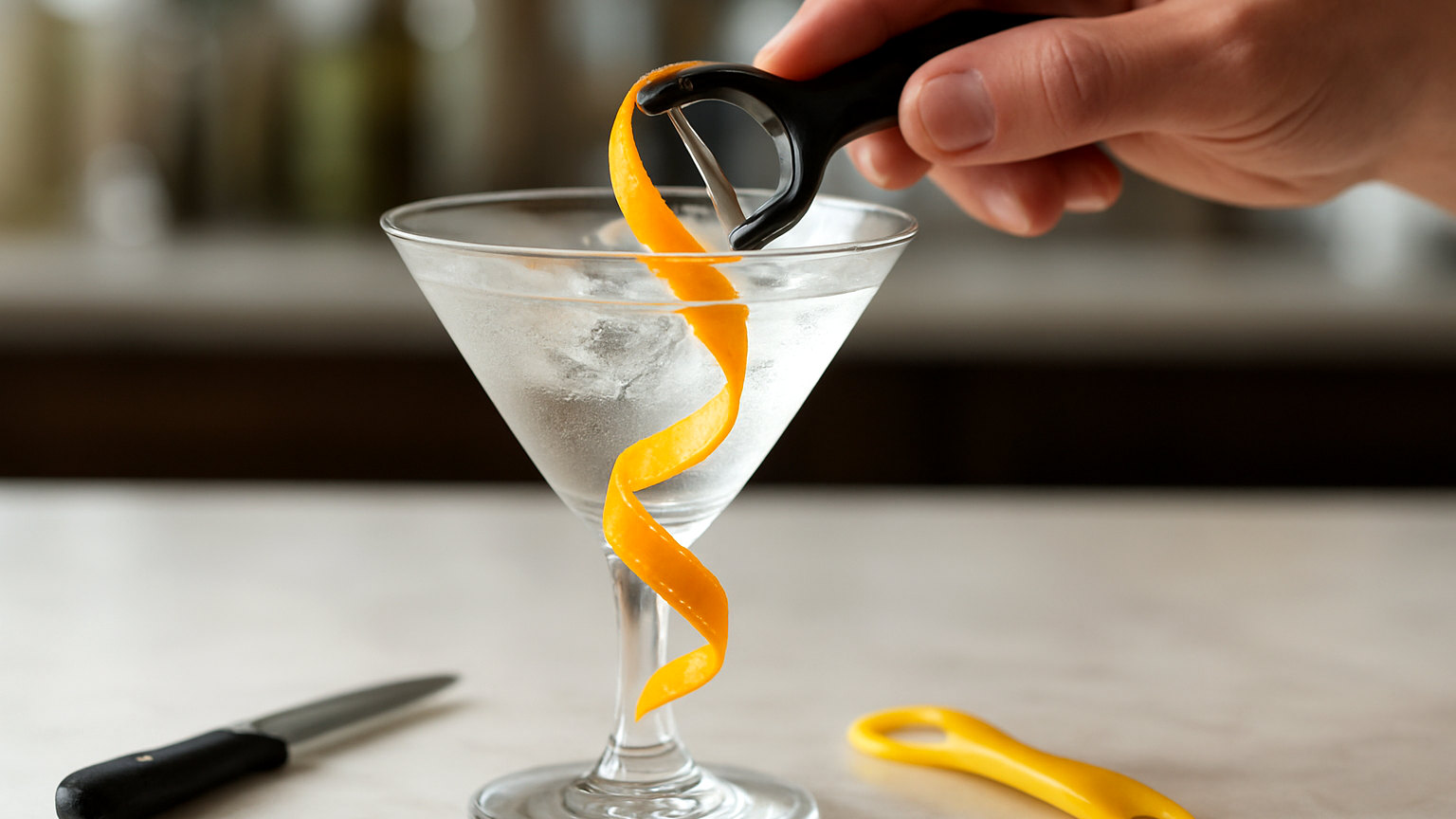
Garnish preparation needs a peeler and a small sharp knife, and neither has to come from a bar supplier. In one case the kitchen tool is genuinely better than the specialist alternative, which is worth knowing before buying a channel knife you will not use.
Which peeler should you use?
A Y-shaped peeler with a sharp blade. It takes a wide strip in a single confident stroke, which is exactly what a citrus twist needs.
Swivel peelers work and require more passes, which increases the chance of digging into the pith. Either beats a channel knife for everyday use.
Why is a peeler better than a channel knife?
Because a channel knife cuts a narrow spiral. It looks decorative and holds far less oil than a wide strip, and oil is the entire point of a twist. A wide peel expressed over a drink sprays visibly; a thin spiral barely does anything.
Channel knives have a place in creating long decorative spirals for presentation. For flavour, the peeler wins.
What knife do you need?
A small paring knife, around 8 to 10cm, kept sharp. That is the whole requirement. A large chef’s knife is unwieldy for cutting a lime into eighths, and a serrated knife tears citrus flesh rather than cutting it.
Sharpness matters more than the knife. A blunt paring knife crushes a lime wedge, which loses juice and leaves a ragged edge.
How do you cut the common garnishes?
- Twist: peeler, 4cm by 2cm, minimal pith. Scrape back if too thick.
- Wheel: cut across the fruit, 3 to 5mm thick. Slit to the centre to sit on a rim.
- Wedge: halve lengthways, then cut each half into three or four.
- Half wheel: a wheel cut in two. Sits flatter on a rim.
Wedges are for squeezing into a drink and wheels are for looks. A wedge adds juice, which changes the acidity, so use one only where that is intended.
How do you deal with pith?
Take as little as possible in the first place by using a sharp peeler and a light touch. If you have taken too much, lay the strip pith side up on a board and scrape it back with the paring knife held almost flat.
Pith is bitter and contributes nothing aromatic, so a twist with a thick white backing will drop bitterness into the drink.
Does the board matter?
Keep a small one with the bar rather than using the kitchen board. Two reasons: onion and garlic residue transfers readily to citrus, and having to fetch a board is exactly the friction that stops drinks being made on a weeknight.
A small plastic board is easier to sanitise than wood and takes up almost no space. Wash it immediately after use, since citrus oil and juice dry sticky.
Should you prepare garnishes in advance?
Only for a party, and only shortly beforehand. Cut citrus dries at the surface within a couple of hours and loses aroma fast, and a bowl of wedges prepared in the morning will be tired by evening.
For a single drink, cut to order. It takes ten seconds and the difference is noticeable.
How should you store the knife?
Not loose in a drawer with other tools, where the edge dulls against everything else and it is a hazard to reach for. A blade guard costs very little.
Keep it sharp with a honing rod or a small sharpener every few weeks. A sharp small knife is safer than a blunt one, since blunt blades slip.
Do you need a citrus juicer?
Not to start. A fork twisted inside a halved lemon works, and rolling the fruit firmly on a worktop first increases the yield noticeably. A small hand press is worth buying if citrus drinks become a weekly habit.
How sharp does the knife need to be?
Sharp enough to cut a lime wedge without crushing it. A blunt paring knife squashes the fruit, loses juice into the board and leaves a ragged edge that looks careless on a rim.
A few passes on a honing rod every couple of weeks is enough. Blunt blades also slip, which makes them the more dangerous option.


