
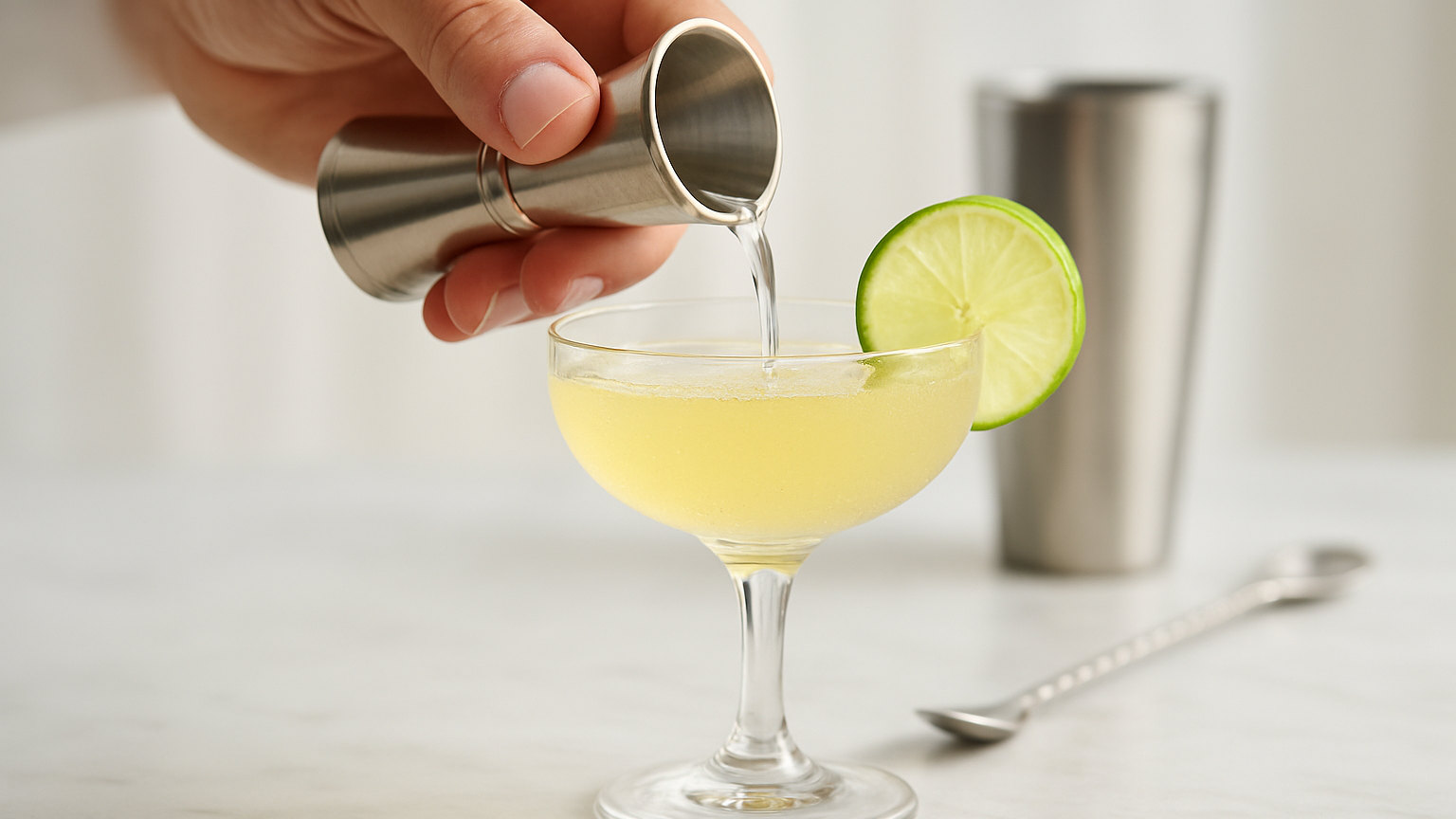
Cocktails are ratios. A daiquiri at 60ml, 25ml and 20ml is a good drink; the same three ingredients at 60, 35 and 15 is a sour, thin one. Since nobody can judge 10ml by eye reliably, the measure is what makes a recipe reproducible.
How should you fill it?
To the very top, or exactly to the graduation line, and hold it level. Surface tension lets liquid sit slightly proud of the rim, which is correct for a full measure rather than an overfill.
Hold the jigger close to the shaker, not over the sink or the worktop. Pouring from a height loses a few millilitres to the sides of the tool and to spillage, and that adds up across three ingredients.
Should you pour into the jigger or from the bottle?
Always into the jigger and then into the shaker. Pouring directly from the bottle while watching a measuring line is how bar staff free pour, and it needs thousands of repetitions to become accurate.
Which measurements do you actually need?
Five cover almost every classic:
- 60ml: a standard spirit measure in a shaken drink.
- 45ml: a lighter spirit measure.
- 30ml: half measures, liqueurs, vermouth.
- 20ml: syrup in most sours.
- 15ml: modifiers and small additions.
A jigger with internal graduation lines covers all five with one tool. The stubby two-sided type only measures its two extremes and forces constant estimation for everything between.
Why does free pouring fail at home?
Because accuracy comes from repetition with a specific bottle and pourer, and it decays fast. Bar staff who count while pouring are calibrated against a particular flow rate, and they are tested on it periodically.
Someone making four drinks a month, from bottles without pourers, at varying fill levels, has none of that. Free pouring at home is guessing with a confident wrist.
How do you measure small quantities?
For 5ml and below, use a teaspoon rather than trying to judge a fraction of a jigger. A metric teaspoon is 5ml, which is exactly the quantity most recipes mean when they say a bar spoon.
For dashes of bitters, use the dasher top on the bottle. A dash is roughly 0.8ml and consistent enough not to need measuring.
What about ounces?
American recipes work in ounces, where a fluid ounce is roughly 30ml. The common conversions:
- 2oz is 60ml
- 1.5oz is 45ml
- 1oz is 30ml
- 0.75oz is 22ml, usually rounded to 20ml
- 0.5oz is 15ml
The 0.75oz rounding is where most conversion confusion happens. Twenty millilitres is close enough and it is what most European recipes specify.
Does the jigger need rinsing between ingredients?
Between a syrup and a spirit, yes, or the syrup clings and the next measure is short. Between two spirits, no. A quick dip in a glass of water kept beside you is enough and takes a second.
When can you stop measuring?
For the mixer in a long drink, since 20ml either way in 150ml of tonic makes no meaningful difference. For everything that goes in a shaker or a mixing glass, keep measuring. Those are the drinks where the ratio is the recipe.
How do you clean it?
Rinse it as you go, particularly between a syrup and a spirit. Keep a small glass of water beside you and dip it, which takes a second and stops syrup clinging to the walls and shorting the next measure.
What size jigger should you buy?
A 30ml and 60ml pair is the most useful combination, with internal lines marking 15, 20 and 45. That covers every measure in a standard cocktail without any arithmetic.
Smaller pairs such as 15ml and 30ml mean pouring four times for a standard spirit measure, which multiplies any small error and takes longer.
Does the shape matter?
A taller, narrower jigger is easier to read accurately than a shallow wide one, because a given volume sits higher up the wall. That is the main practical reason the Japanese style is preferred.


